Engineering
Underwater glider
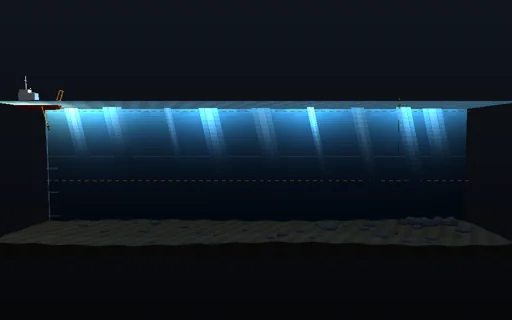
Send a yellow underwater glider from a research ship across three kilometres of open ocean with no propeller at all: an oil bladder in its nose swells and shrinks by a quarter of a litre, the battery slides a centimetre forward or aft, and the swept wings turn the slight sinking or rising into a long glide. It flies a saw-tooth down through the sunlit water and the thermocline into the dark, where plankton flash in its wake, and every steady dive and climb matches its closed form - tan γ = CD/CL, the speed from the net buoyancy, the pitch from the balance of moments. Pumping the oil out at 150 m costs 2ΔV·p; compare shallow and deep cycles, trim the battery, give it too small a bladder and watch the dive stall at the neutral depth in the thermocline, soften the hull, or fly against a current; the range on one battery is estimated from every cycle and each joule is followed into the water.
What happens
A 53.3 kg glider, 1.5 m long, displacing 52 litres, ballasted 150 g heavier than neutral in the warm surface water (1023 kg/m³). Below 25 m a thermocline raises the density to 1026.2 kg/m³ at 65 m; water and hull compress, so the displaced mass is ρ(d)·V·(1 + (κw − κh)·ρ0·g·d) with κw = 4.4×10^-10/Pa and an aluminium hull at 2×10^-10/Pa. The oil bladder swings ±250 cm³ at 5 cm³/s; pumping out at depth d costs 2ΔV·p(d)/η with η = 0.5, letting the oil back in at the top is free. A 9 kg battery slides ±11 mm at 2 mm/s; with the centre of gravity 6 mm below the centre of buoyancy it sets the pitch. The vehicle is a rigid body in the vertical plane with added mass 5 kg along and 60 kg across the hull, so the Munk moment comes out of the equations; lift CL = 3.2 sin α cos α, drag CD = 0.1 + 2 sin²α, a pitching moment and a pitch damping. In a steady glide tan γ = CD/CL, the speed follows from the net buoyancy, V² = 2|B|/(ρS·√(CL² + CD²)), and the pitch from the balance of moments: at 150 m the dive goes at 29.6° and 0.44 m/s, the climb at 31.9° and 0.53 m/s, steeper than the best glide of 15.6°. The controller dives to the set depth, pumps and climbs to 5 m, dives again until the track has passed the end of the transect, then rises to the surface and stops. A dive that cannot reach its depth turns round after an hour. RK4 in 50 ms steps; kinetic and potential energy follow pump and battery work less the work taken by the water to 10^-9. Horizontal scale 1:100, vertical 1:20 (glide angles drawn five times steeper); the glider ×50, the ship ×5.
Try this
Watch the first dive through the thermocline and compare speed and glide angle with the closed form; read the pump energy at the bottom; set 50 m or 200 m dives and compare the energy per kilometre; trim the battery forward; shrink the bladder to 100 cm³ with no ballast and watch the dive stall at the neutral depth; soften the hull; fly against a current.
The model and its limits
A planar glider on quasi-steady polars with constant coefficients: no roll, yaw or steering, no stall model, no surface waves; the current is uniform and constant, the thermocline linear, the pump efficiency and hotel load fixed, the battery range an estimate from the last cycle. The ship and the buoy are scenery.
Equations used in the module
Equations
m_d(d) = ρ_s(d)·(V + ΔV)·(1 + (κ_w − κ_h)·ρ0·g·d),  B = g·(m_d − m),  W_pump = ∫ g·I(d) dΔV ≈ 2ΔV·p(D)
m1·du/dt = F1 + m3·w·q,  m3·dw/dt = F3 − m1·u·q,  J·dq/dt = −g·(m_b·r·cos θ + m·h·sin θ) + M_h − K_q·q + (m1 − m3)·u·w
C_L = C_Lα·sin α·cos α,  C_D = C_D0 + C_Dα·sin²α,  tan γ = C_D/C_L,  V² = 2|B|/(ρ·S·sqrt(C_L² + C_D²))
T + U(d, ΔV, r, θ) − E0 = W_pump + W_battery − ∫(D·V − M_h·q + K_q·q²) dt,  x_ground = x_water + U·t