MakarovSuites
English
EnglishDeutschРусскийУкраїнськаFrançaisEspañolItalianoPolski
Contact & licences

Engineering

Railway bogie

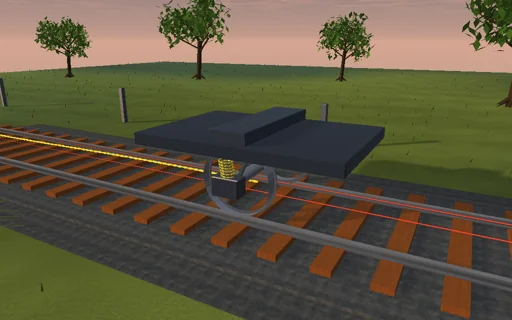
Run a wheelset with coned treads along a test track and watch the path it takes drawn on the ballast, thirty times enlarged. A free wheelset rolls Klingel’s sinusoid, 2 pi sqrt(b r0/lambda) long; tied to its bogie by lateral and yaw springs it is stable up to the critical speed the Routh-Hurwitz test gives, and a kick dies away - go ten per cent faster and the same kick grows into hunting from flange to flange. Wear the treads to a steeper cone and the critical speed drops, stiffen the yaw spring and it rises; put the track into a curve and the wheelset settles at the offset where creep and suspension balance.
Railway bogie — Actual application image
Actual application image

What happens

One wheelset of 1250 kg with 1:6.7 coned treads (lambda 0.15) and wheel radius 0.46 m, tied to its bogie by a lateral spring of 1 MN/m and a yaw spring of 2 MN·m/rad. Kalker’s linear creep coefficients of 8 MN give the longitudinal and lateral forces, saturating smoothly at the adhesion limit; the flanges stop it 7.5 mm off centre with a stiff spring. A free wheelset rolls Klingel’s sinusoid 2 pi sqrt(b r0/lambda); the quartic of the suspended wheelset gives the critical speed by the Routh-Hurwitz test. In a curve the wheelset settles where creep and suspension balance. RK4 at 0.5 ms; the path is drawn thirty times enlarged.

Try this

Kick the wheelset below the critical speed and watch it settle; go ten per cent faster and see it hunt; wear the treads to a steeper cone; stiffen the yaw spring; put the track into a curve.

The model and its limits

A single wheelset with linear creep and a smooth saturation, a constant conicity, a spring flange, no bogie frame dynamics or second wheelset. Critical speeds are those of this idealized wheelset.

Equations used in the module
Equations
m·a_y = −2f22·(v_y/V − ψ) − k_y·y − F_flange
I·α_ψ = −2b·f11·(b·ω_ψ/V + λ·y/r0 − b/R_c) − k_ψ·ψ
λ_K = 2π·√(b·r0/λ)
a3·a2·a1 − a3²·a0 − a1²·a4 = 0  →  V_crit
Related experiments

Back to catalogue
Walking excavator — Actual application image

Engineering

Walking excavator

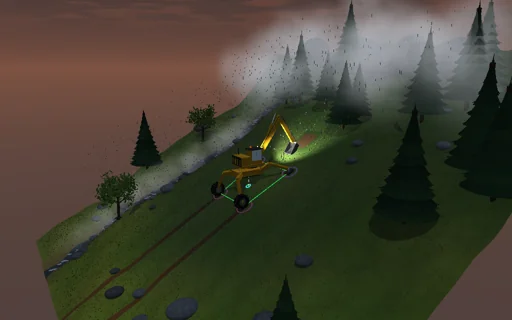
Work a yellow spider excavator on a steep alpine meadow in the drizzle. Its body is levelled on four telescopic legs, two clawed pads and two wheels, and the support polygon between them is drawn on the grass with the plumb line from the centre of mass: green while the margin is wide, red near tipping. The four pad loads are statically indeterminate and follow from the pads’ compliance; a pad that would pull lets go. Dig a trench, lift the full bucket and swing it: the hydraulic work goes into height, cutting and valve heat to the joule. On wet turf the machine slides at atan μ = 33° long before it tips. Face downhill on hard soil and the breakout force tips it over its front pads at the closed-form force, unless a lower relief pressure stalls the bucket first. Lift a leg: the uphill front leg comes free, a downhill one is refused until the boom swings over.

Aerial rescue ladder — Actual application image

Engineering

Aerial rescue ladder

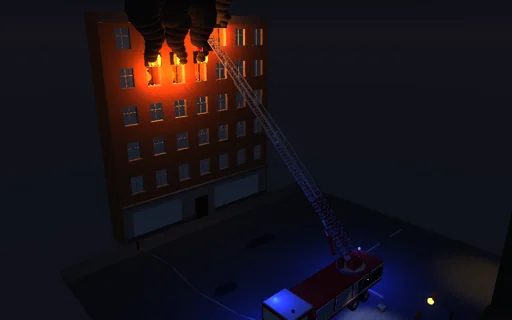
At night before a burning house a fire truck stands on its four outriggers and raises its turntable ladder to a window on the top floor. The four telescopic sections bend as a stepped cantilever whose closed-form deflection agrees with the unit-load integral, and the ladder is drawn bent by it, magnified. When a second person steps into the cage the tip drops by m g cos θ/k and overshoots, then sways at the first bending frequency sqrt(k/m_eff)/2π, dying away with the logarithmic decrement 2πζ; a gust sets it swaying too. Draw the outriggers in and the pads share the load ever more unevenly - at 1.5 m one lifts while the cage sways, at 1.2 m the truck would tip. The load chart gives the safe load against the reach, and the work of the loads is followed into the sway and the damping.