Math
Complex mapping
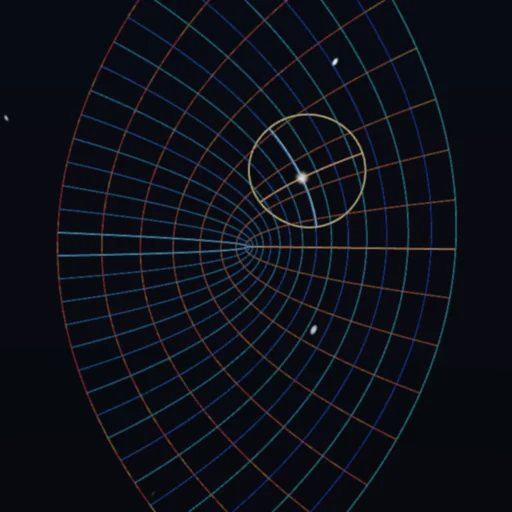
A grid morphing under z², z³, 1/z, e^z, sin z, a Möbius map and the Joukowski map: the right angles survive everywhere f′ ≠ 0, and the probe circle measures |f′|, arg f′ and the winding at the critical points.
What happens
Two panels. On the left the z plane with a square grid - vertical lines coloured by their x, horizontal ones by their y, so every line can be recognised after the function has bent it. On the right the same grid after g_t = (1 − t)·z + t·f(z), and t sweeps 0 → 1 → 0: the grid flows into parabolas under z², circles through the origin under 1/z, rays and circles under e^z, confocal ellipses and hyperbolas under sin z, the unit disc under (z − i)/(z + i), the Joukowski ellipses under z + 1/z, and back. Every frame of the morph is itself holomorphic - a sum of holomorphic maps is one - so every frame is CONFORMAL: the right angle between the two coloured families survives all the way through, wherever the derivative is not zero. The golden probe circle with two arms sits on the domain (drag it with the left button, or let the tour carry it); its image on the right is a small circle scaled by |f′| and turned by arg f′, with its arms still at right angles. Where f′ = 0 the angles multiply instead: the image of the circle winds twice round z²'s origin, three times round z³'s, and the arms open to 180°. The panel measures all of it off the circle and prints the closed form beside each number. One more thing to watch: the morph has critical points of its own, at f′(z) = −(1 − t)/t. For z² that is a single fold walking in along the real axis from −∞ to 0 - it is marked in the domain - and the grid creases exactly there, and nowhere else.
Equations used in the module
Equations
w = f(z),  f holomorphic:  u_x = v_y,  u_y = −v_x  (Cauchy–Riemann),  Δu = Δv = 0
conformal where f′(z) ≠ 0:  a small circle of radius r → a circle of radius r·|f′|, turned by arg f′;  angles are kept
at an n-fold critical point angles are multiplied by n:  the image of a small circle winds n times  (2 for z² at 0, 3 for z³)
morph:  g_t(z) = (1 − t)·z + t·f(z),  g_t′ = (1 − t) + t·f′  - holomorphic for every t;  its folds solve f′(z) = −(1 − t)/t  (z²:  z = −(1 − t)/(2t))
z²:  x = c → v² = 4c²(c² − u);   1/z:  x = c → |w − 1/(2c)| = 1/(2|c|);   e^z:  x = c → |w| = e^c,  y = c → arg w = c
sin z:  x = c → u²/sin²c − v²/cos²c = 1,  y = c → u²/cosh²c + v²/sinh²c = 1  (foci ±1)
(z − i)/(z + i):  real axis → unit circle,  Im z > 0 → |w| < 1;   z + 1/z:  |z| = 1 → [−2, 2],  |z| = R → ellipse (R + 1/R, R − 1/R)
argument principle:  the image of |z| = R winds round 0 exactly (zeros − poles) times
roundness of the image of |z − z₀| = r:  z² → 1 + r/(|z₀| − r/2),  e^z → e^r exactly