Math
Riemann surfaces
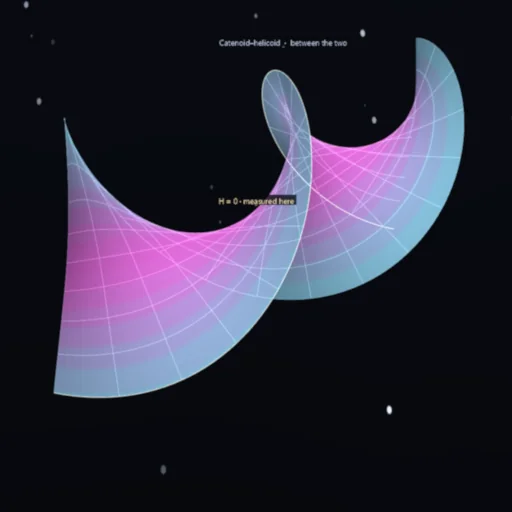
The sheets of the complex logarithm and the square root, joined along their branch cuts.
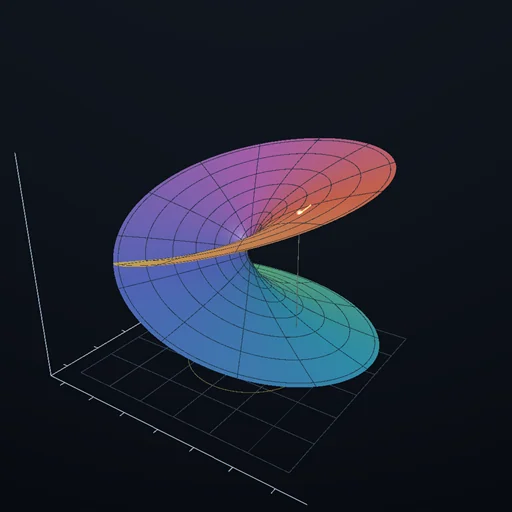
What happens
w = √z has two values at every z but zero, and the surface of all (z, w) is ONE thing: follow z once round the origin and w comes back with the other sign - monodromy, the reason a Riemann surface is a surface and not two graphs. The height drawn is Re(e^{iφ}w) with an adjustable projection angle φ; the surface is the shadow of something in four dimensions, and turning φ turns that thing, so the sheets pass through one another while the branch point never moves. For the logarithm the same turn morphs a funnel into a helicoid. Colour shows the plotted height by default; phase colouring is optional. The projection starts still; its angle and rotation speed can be adjusted. A walker goes round a loop in the plane below, its image climbs the surface, and the panel prints what the loop did to w. Move the loop onto one branch point of √(z² − 1) and the sign flips; round both, it does not.
Equations used in the module
Equations
w = √z:  w(r, θ + 2π) = −w(r, θ)   (two sheets, one branch point)
w = z^(1/n):  a loop multiplies w by e^(2πi/n);  n loops restore it
w = log z = ln r + iθ:  every loop adds 2πi   (the helicoid never closes)
w = √(z² − 1):  a loop round one branch point flips the sign, round both it does not
y = s Re(e^(iφ) w);  s = 0.9 × scale (roots), 0.28 × scale (log);  colour: y / arg w