Engineering
Compound pulley hoist
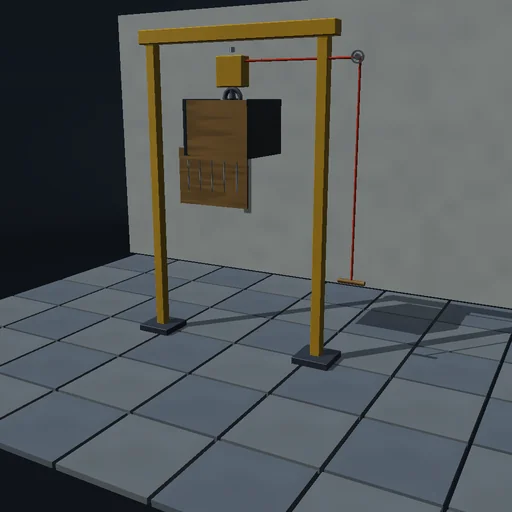
Pull the free end of a block and tackle and lift a crate: compare one, two and three moving sheaves at the same force, read the strand tensions and the real mechanical advantage against the ideal one, release the rope and watch the load run back against the sheaves’ friction and inertia.
What happens
A block and tackle hangs from a gantry: a fixed block and a moving block with the same number of sheaves, the rope anchored at the fixed block, so 2n strands carry the crate and the free end runs 2n times as fast as the load. The rope is treated as massless: over every sheave its tension grows by 1 + μ·r_a/R in the direction it runs, and each sheave’s inertia adds J·j·a/R² to the next strand, the rope passing sheave j at j times the load’s speed. The statics are solved every millisecond for the load’s acceleration; a force between the hold and raise forces holds the load by friction, the ground carries it below, and the blocks meet at the top. The ledger of work, height, kinetic energy and loss closes to rounding without friction.
Try this
Pull harder than the raise force and the crate rises; drop below the hold force and it runs back. Compare the strand count against the real advantage and the free-end speed against the load’s.
The model and its limits
Massless rope without stretch or bending stiffness, sheaves on dry axle friction with a constant ratio, no rope-sheave slip or wrap friction. Not a design calculation for a real hoist.
Equations used in the module
Equations
v_free = 2n·v,  k = 1 + μ·r_a/R
T_(j+1) = k·T_j + J·j·a/R²,  Σ T_j = M·(g + a)
m_eff = M + J·n(n+1)(2n+1)/(6R²)
MA = M·g/F_raise,  η = MA/(2n)