Engineering
Winch and holding brake
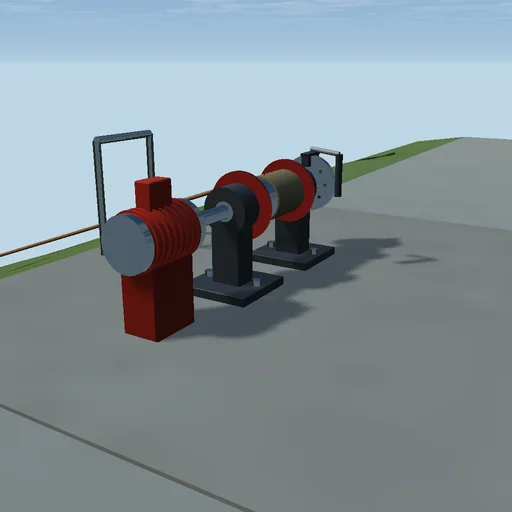
Haul a sled up a hillside with a drum winch: the rope snaps taut, the drum slows as each new layer of rope grows its radius, and the energy the motor spends is booked against the load’s height, the friction and the rope. Then stop the motor and hold the load with the brake or the pawl, weaken the brake and watch the load run back against it, or let it run away.
What happens
A drum winch on a pad at the top of a slope hauls a sled 25 m below it. The motor sits on a straight torque-speed line from its stall torque to its no-load speed; the rope winds in layers of twenty turns, each layer half a rope diameter further from the axis, so the effective radius grows and the drum slows; the rope is elastic with EA = 10 MN over its free length, damped at a tenth of critical, and goes slack when it is shorter than the span. The sled sees gravity and Coulomb friction with a stick state; the brake is a Coulomb torque with its own stick state, the pawl stops the drum from turning back. Semi-implicit Euler at 0.1 ms with midpoint positions, so every joule of the motor’s work is found in the load’s height and energy, the rope’s stretch and the heat of friction, brake and damping.
Try this
Watch the rope snap taut and the sled start, then the drum slow as the second layer begins. Stop the motor and try the brake alone, a weaker brake, the pawl, or nothing.
The model and its limits
Rope wound in ideal layers of equal turns, no rope mass or fleet angle, a linear motor characteristic without thermal limits, Coulomb friction with a stick band. Not a rating of a real winch.
Equations used in the module
Equations
T_m = T_s·(1 − ω/ω_0),  J·dω/dt = T_m − T·r − T_b − c·ω
r = r_0 + d·(layer + ½),  T = k·δ + c_r·dδ/dt,  k = EA/L_free
m·dv/dt = T − m·g·sin θ − μ·m·g·cos θ·sgn v
W_motor = E_p + E_k + E_el + Q_fr + Q_br + Q_d