Games
Curling
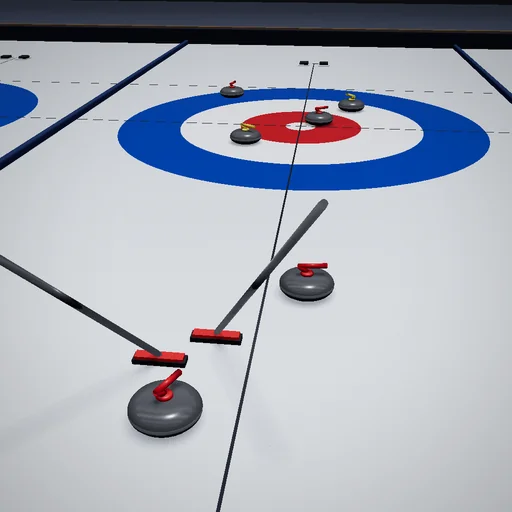
Curling on a full sheet of pebbled ice: eight granite stones a side in each end, the side without the hammer throwing first, the end counted by the stones nearest the button, and extra ends after a tie. The hog line, the back and side lines and the free guard zone of the first five stones are kept. A stone slides for half a minute, curls toward the way it turns - most as it slows - and the sweepers carry it farther and straighter while you hold Space. Place the skip's broom with the mouse, choose the weight and the turn, and throw. Play the computer at five levels - it guards, draws round, freezes and hits, and sweeps its own draws - play a friend, practise your draw weight alone, or watch a demo game.
What happens
Curling by the rules. In each end both sides deliver eight stones in turn, from the hack at the near end toward the house at the far end; the side without the hammer throws first, the side with it throws the last stone. A stone must be let go before the near hog line; one that does not come to rest wholly past the far hog line is removed, unless it struck another stone in play; one that touches a side line, or comes to rest wholly past the back line, is out of play. Free guard zone: before the sixth stone of an end, an opponent's stone between the hog line and the house may not be put out of play - if it is, the stones are put back and the delivered stone removed. When all sixteen stones are played, the side with the stone nearest the tee scores a point for each of its stones in the house nearer than the other side's nearest; the side that scores throws first in the next end, and a blank end leaves the hammer where it was. Level after the last end, extra ends are played. At draw weight a stone slides about half a minute, turns about three times and curls toward the side it turns to - clockwise to the right - most of all as it slows; sweeping in front of it lowers the friction, so it runs farther and curls less. The computer plays draws, guards, come-arounds, freezes, takeouts, taps, raises and peels; the weaker levels see fewer shots and throw less precisely, and the weakest does not sweep.
Try this
Place the broom with the mouse, set the weight and the turn on the card, then press on the ice, draw back and let go - or press Space. Hold Space or the left button to sweep your stone. The right mouse button turns the view, the wheel zooms.