MakarovSuites
English
EnglishDeutschРусскийУкраїнськаFrançaisEspañolItalianoPolski
Contact & licences

Earth

Glaciers shape valleys

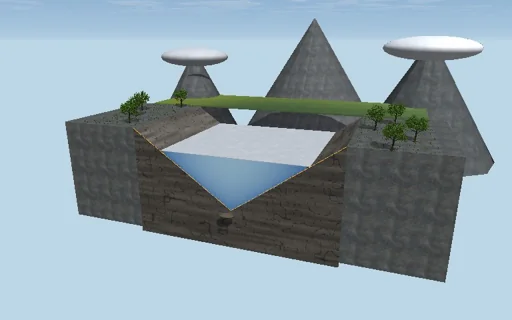
Fill a river’s V-shaped valley with a glacier six hundred metres thick and watch a hundred thousand years go by. The ice flows fastest at the middle of its surface and not at all against the bed; the shear it drags along the bed is greatest on the walls of the V and vanishes in its narrow floor, so sliding and abrasion cut the walls back and the valley widens towards a U - the old V stays drawn for comparison. Clean ice cuts far less than ice full of rock; with no sliding it cuts nothing; let the glacier advance and retreat in cycles. Every cubic metre the bed loses goes to the moraine. In a semicircular channel the solve is the closed-form Poisson solution.
Glaciers shape valleys — Actual application image
Actual application image

What happens

A valley cross-section 2400 m wide on a grid of 61 by 40. The down-valley velocity of Newtonian ice (10¹³ Pa·s, slope 0.05) solves eta grad²u = −rho g sin alpha with u = 0 on the bed and du/dz = 0 at the surface; the irregular bed is met by Shortley-Weller differences and the solution by over-relaxation from the last one. The shear on the bed drives sliding in proportion - a stated simplification, the sliding does not enter the solve - and the sliding abrades the bed (Hallet), scaled by the debris in the ice and the rock’s strength. Every cubic metre goes to the moraine. Steps of 1 thousand years; one second is a thousand years at time scale 1.

Try this

Watch the V widen towards a U and read the profile exponent; compare clean and dirty ice; stop the sliding; let the glacier advance and retreat in cycles; check the semicircle against the closed form.

The model and its limits

A cross-section without along-valley flow, Newtonian ice, sliding proportional to the computed shear, a single abrasion law; plucking and rock fracture are not modelled. Profiles belong to this idealized valley.

Equations used in the module
Equations
η·∇²u = −ρ·g·sin α,  u = 0 on the bed,  ∂u/∂z = 0 at the surface
τ_b = η·|∇u| at the bed,  u_b = c_s·τ_b
dz_b/dt = −K·D/S·u_b·√(1 + (∂z_b/∂y)²)
semicircle: u = ρ·g·sin α·(R² − r²)/(4η),  τ_b = ρ·g·sin α·R/2
Related experiments

Back to catalogue
Permafrost and thaw — Actual application image

Earth

Permafrost and thaw

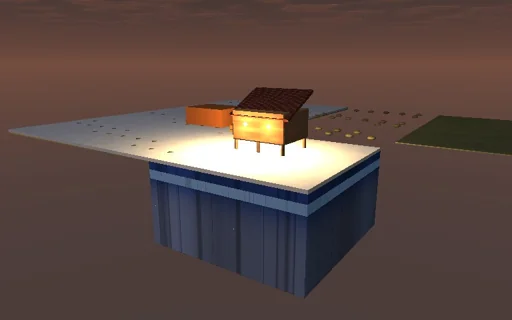
Watch the ground under a tundra house through the seasons: each summer the top thaws to the depth of the active layer, each winter it freezes again, and below the ground stays frozen at the melting point of its ice. A thick snow cover keeps the winter cold out and the ground five degrees warmer; scrape it away and the permafrost hardens. Warm the climate by a degree a decade and the active layer deepens year by year until the ice-rich layer thaws and the house settles by its excess ice. The latent heat of the ice holds the thaw front back exactly as Neumann’s solution says, and the heat that crossed the surface and the base is the enthalpy the column gained.

Waves shape a coastline — Actual application image

Earth

Waves shape a coastline

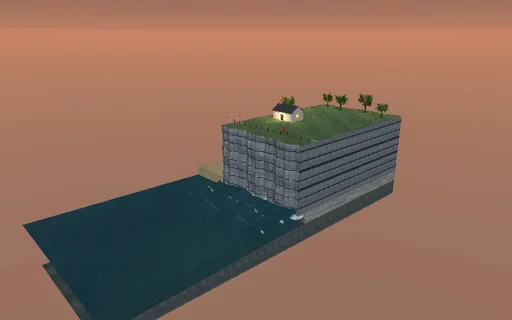
Watch a century go by on a white chalk headland under a grey, windy sky. The breakers cut a notch at the foot wherever their force beats the rock’s resistance; the overhang above hangs like a cantilever until the tension at its root reaches the strength of the chalk, and then the whole block comes down. Its talus shelters the foot until the waves wear it away, and only then does the next notch grow, so the edge steps back a few metres at a time at the closed-form mean rate of that cycle - past the coast path, the fence and, one day, the cottage. Make the waves higher, the chalk weaker or stronger, add a harder band or a seawall; raise the sea and bigger waves reach the foot, while the sandy cove beside it moves its shoreline back by the sand balance and Bruun’s rule. The rock lost balances the notch, the talus worn and the talus left.

Tides in an estuary — Actual application image

Earth

Tides in an estuary

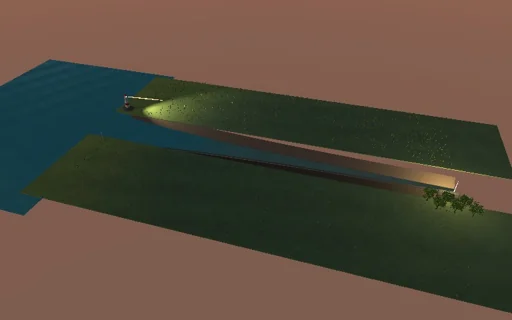
Watch the evening tide run up a funnel-shaped estuary past the lighthouse: the channel narrows towards the river, so the wave rises as it goes and the range at the head is far larger than at the mouth, the flood is shorter than the ebb, and the salt sea water pushes tens of kilometres inland against the river. Raise the river’s discharge and the salt is pushed back towards the sea; make the funnel sharper or straighten it; close the head and the channel resonates as a quarter-wave, the head’s tide a / cos(kL) of the sea’s. Calm closed water stays exactly calm, a salt estuary with no river stays exactly salt, and the water and salt balance against what crossed the mouth and the head.