Earth
Jet stream and Rossby waves
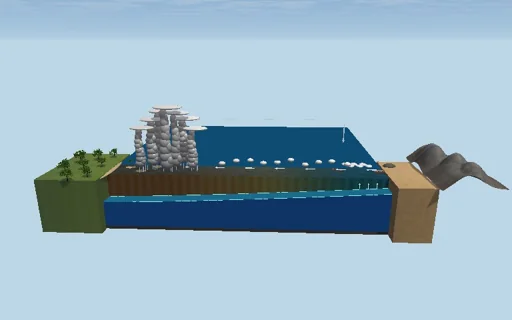
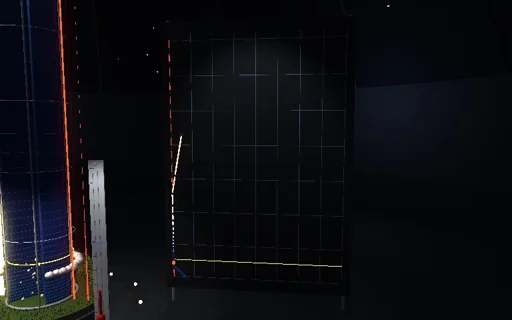
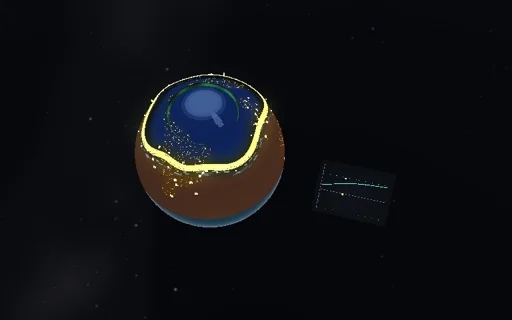
Look down on the northern hemisphere in the polar night: the jet stream glows as a ribbon round the pole, coloured by its wind, with cold Arctic air tinting the ground blue on its poleward side and warm air orange on the other. Its strength is the thermal wind of the equator-to-pole contrast, 25 m/s for 40 K at 500 hPa. Its meanders are Rossby waves of the barotropic vorticity equation: a free wave drifts east at the closed-form c = U − β/(k²+l²), far slower than the balloons riding the wind, and stands still when U = β/K². The Rockies and Tibet force waves locked to the mountains. Weaken the contrast as a warming Arctic does and the jet slows, the stationary waves grow shorter and the troughs reach further south; over a single-wave ridge the slower jet falls into resonance, the mountain drag holds it there and the wave stays blocked even when the contrast comes back.
What happens
The 500 hPa flow as the barotropic vorticity equation on a β-plane round 45°N: the whole latitude circle Lx = 28 300 km, Ly = Lx/2, 64 × 32 points, f0 = 1.03·10^-4 1/s, β = 1.62·10^-11 1/(m·s). The streamfunction is Ψ = −U·y + ψ: a mean westerly U and a periodic part whose vorticity ζ = ∇²ψ also holds the jet’s shear; mountains add η = f0·h/D with D = 10 km. ∂ζ/∂t + J(ψ, ζ + η) + U·∂(ζ + η)/∂x + β·∂ψ/∂x = −r·(ζ − ζ_T) − ν·∇⁴ζ, and the mountains’ form drag brakes the mean wind: dU/dt = ⟨η·∂ψ/∂x⟩ + r·(U_T − U). The westerlies relax in 1/r = 10 days to the thermal-wind jet u_T = U0·G(y), Gaussian of 1800 km near its axis, U0 = g·H·ΔT/(f0·T·L_J) with H = 5.5 km, T = 250 K and L_J = ∫G dy = 3356 km: 24.9 m/s for ΔT = 40 K. Pseudo-spectral with the 2/3 rule, so that without friction the energy U²/2 + ⟨|∇ψ|²⟩/2 and the potential enstrophy ⟨(ζ + η)²⟩/2 + β·U are conserved; RK4 in steps of at most an hour, a hyperviscosity that damps the shortest wave in a day, the forcing and dissipation booked with the same weights. Twenty-four balloons ride the total wind. The Rockies (0.7 of the peak) and Tibet (3000 m) are Gaussian ranges; the single ridge is h·cos(k·x)·cos(2π·y/Ly). Closed forms: c = U − β/(k² + l²), standing still at U = β/K² (16.4 m/s for wave 4), the forced wave ψ = i·k·U·η/(K²·(i·ω + r′)) and the balance r·(U_T − U) = U·k²·r′·⟨η²⟩/(K²·(ω² + r′²)) with its zonal and blocked roots. The isotherms follow the streamlines, T′ = f0·T·Ψ/(g·H).
Try this
Send a free wave round and compare the crest with the balloons and with c = U − β/(k²+l²); find the contrast at which it stands still; let the jet settle over the Rockies and Tibet, then halve the contrast; over the single ridge lower the contrast to 30 K, wait for the block and raise it back to 40 K.
The model and its limits
One barotropic layer on a β-plane: no baroclinic storms, no vertical structure of the jet, no curvature of the sphere; the periodic channel is drawn on the globe only between about 13° and 77°N and faded towards the pole. The jet is held by relaxation to a prescribed thermal wind, not by the eddies; the blocked state belongs to this one-wave ridge, not a forecast of real blocking.
Equations used in the module
Equations
∂ζ/∂t + J(ψ, ζ + η) + U·∂(ζ + η)/∂x + β·∂ψ/∂x = −r·(ζ − ζ_T) − ν·∇⁴ζ
dU/dt = ⟨η·∂ψ/∂x⟩ + r·(U_T − U),  U0 = g·H·ΔT/(f0·T·L_J)
c = U − β/(k² + l²),  c_g = U + β·(k² − l²)/K⁴,  L_s = 2π·√(U/β)
r·(U_T − U) = U·k²·r′·⟨η²⟩/(K²·(ω² + r′²)),  ω = k·(U − β/K²)