Earth
Ocean and atmosphere: ENSO
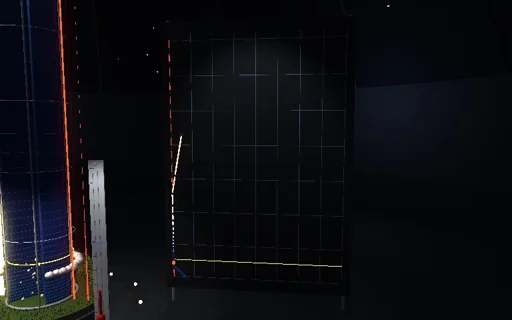
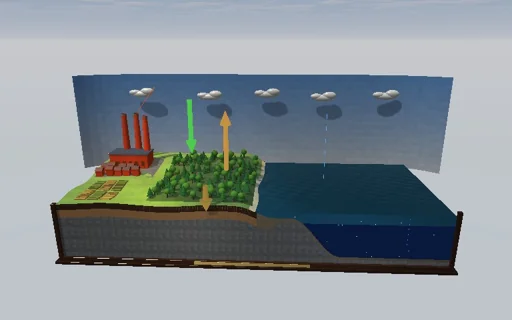
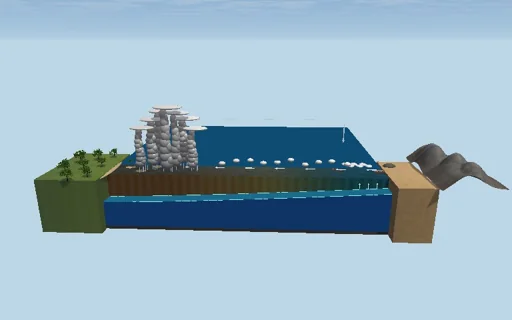
Watch El Niño come and go across the equatorial Pacific, cut open from Indonesia to Peru: the trade winds pile warm water in the west and lift the cold thermocline in the east; warm the east and the trades weaken, the thermocline flattens and the east warms further - the Bjerknes feedback - while the slow discharge of the warm-water volume turns the event into La Niña about a year and a half later. Below a closed-form critical coupling the swing dies away, at it the oscillation neither grows nor fades and its period is 2π/ω from the linear eigenvalues, above it a limit cycle settles at the amplitude of weakly nonlinear theory. Send a westerly wind burst or a noisy atmosphere and watch the rain clouds migrate east; switch the atmosphere off and the oscillation is gone.
What happens
Jin’s recharge oscillator in months: the eastern sea-surface anomaly T (the Niño index) and the western thermocline depth anomaly h_W obey dT/dt = R·T + γ·h_W + γ·ξ − ε·T³ and dh_W/dt = −r·h_W − α·(b·T + ξ), with the Bjerknes tilt response b = μ·30 m/K, R = γ·b − c, γ = 0.03125 K/(m·month), damping c = 1/2 per month, recharge r = 1/8 per month, α = 1/16 per month and ε = 0.01 per K² per month; ξ is a wind-stress forcing in metres of tilt - a three-month westerly burst of 12 m and an optional monthly noise from a fixed seed. The eastern depth anomaly is h_W + b·T + ξ about mean depths of 150 m in the west and 50 m in the east; the Walker circulation follows the zonal temperature gradient. The linear eigenvalues σ ± iω, σ = (R − r)/2, give 2π/ω = 3.6 years at μ = 0.70 and no growth at μ_c = (c + r)/(γ·30 m/K) = 2/3; above it the cubic term holds a limit cycle of amplitude √(4σ/(3ε·Re w1)) ≈ 2.04 K. RK4 at 1/32 month; a shadow state carried by the exact matrix exponential shows the departure from linear theory over each cycle.
Try this
Watch the default El Niño cycle settle; drop the coupling below the neutral value and see it die away, set it to neutral and see it hold; send a westerly burst or turn on the noise and watch the rain move east; switch the atmosphere off and the oscillation is gone.
The model and its limits
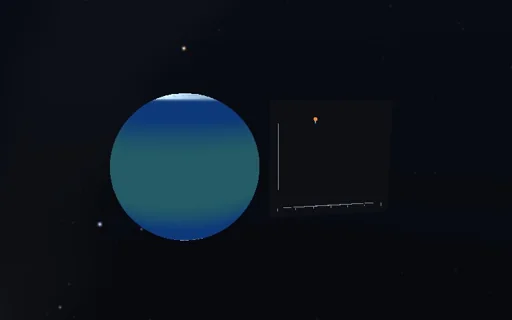
A two-variable recharge oscillator with one eastern temperature and one western thermocline depth: no seasons, no spatial waves, no real wind records. The period and the strength of events belong to this model; the real ENSO calendar and its regional effects are not predicted. The sea-surface, thermocline and cloud fields along the section are drawn from the two numbers.
Equations used in the module
Equations
dT/dt = R·T + γ·h_W + γ·ξ − ε·T³,  R = γ·b − c,  b = μ·B
dh_W/dt = −r·h_W − α·(b·T + ξ),  h_E = h_W + b·T + ξ
λ = σ ± iω,  σ = (R − r)/2,  ω² = γ·α·b − ((R + r)/2)²,  μ_c = (c + r)/(γ·B)
|T| = √(4σ/(3ε·Re w1)),  x(t) = e^(A·t)·x0,  P = Φ·P·Φ^T + q·ψ·ψ^T