Math
Julia sets
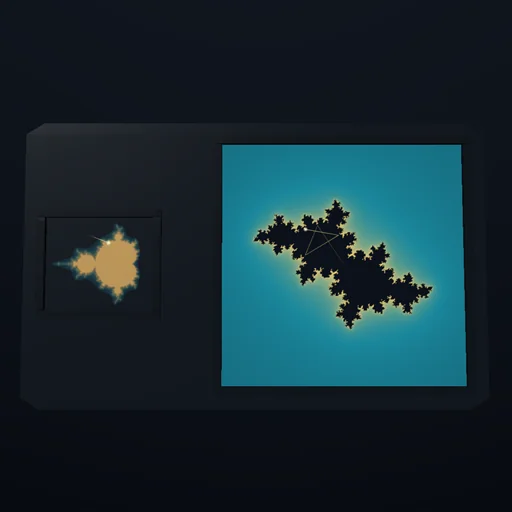
The filled Julia set of z² + c as a living island: drag c across the Mandelbrot map, watch the island morph - and shatter into dust the moment the critical orbit escapes.
What happens
One point decides the whole shape. The map on the left is the parameter plane with the Mandelbrot set on it; the golden marker is c, and the relief in the middle is the filled Julia set of z² + c - an island whose interior never escapes, the exterior falling away along the potential. The theorem carrying the module (Fatou-Julia): the island is connected exactly when the orbit of the critical point 0 stays bounded - one golden orbit, hopping above the relief, answers for every point at once. Inside the main cardioid that orbit settles on a fixed point whose multiplier is the cardioid parameter λ itself; in the disk |c + 1| under 1/4 it settles on a 2-cycle with multiplier 4(c + 1) in closed form; at the rabbit and the airplane - the roots of c³ + 2c² + c + 1 - the cycle has period 3. Push c out of the Mandelbrot set and the island shatters into Cantor dust at the same moment the orbit flies away. The panel measures the period, the multiplier and the island's area: π at c = 0, where the island is the unit disk.
Equations used in the module
Equations
z → z² + c;  filled set: every z whose orbit never escapes
Fatou-Julia:  connected when the orbit of 0 is bounded - Cantor dust otherwise
cardioid  c = λ/2 − λ²/4, |λ| under 1:  a fixed point attracts, its multiplier IS λ
period 2:  the cycle solves z² + z + c + 1 = 0, multiplier 4(c + 1):  the disk |c + 1| under 1/4
period-3 centres:  c³ + 2c² + c + 1 = 0 - the rabbit and the airplane
Green:  G = lim log|z_n|/2^n,  G(z² + c) = 2·G(z),  G = 0 on the filled set