Astronomy
Saturn's rings
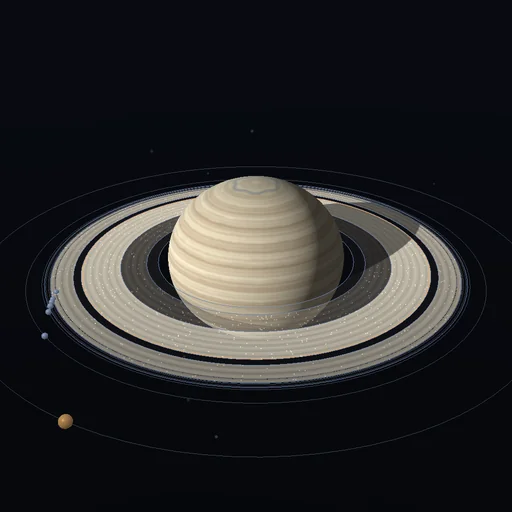
A ring is not a disc: every particle keeps its own Kepler period, so the inner edge laps the outer and any pattern shears away. Where the gaps are is a separate question, and the resonance circles answer it.
What happens
Nothing here rotates together. Each particle keeps the period its own radius gives it, so the inner edge of ring B laps the outer edge of A 1.81 times per outer orbit, and two particles a hundred kilometres apart in radius drift three hundred pi kilometres along the arc every orbit - almost regardless of where they are. That is why no spoke or lump survives, and why the gaps need a different explanation. The bright circle is computed: the radius where a particle turns p times per q turns of the moon you picked. The faint circles are MEASURED - the observed edges of the rings and the centres of the gaps. When the two coincide you can see why the gap is there: Mimas 2:1 lands within half a percent of the inner edge of the Cassini division, Janus 7:6 within a tenth of a percent of the A ring's outer edge, and Pan and Daphnis sit in the middles of their own gaps to five and one kilometre. But Mimas 3:1 lands where there is no gap at all - a resonance alone does not clear one.
Equations used in the module
Equations
every particle keeps its own Kepler period: T(r) = 2 pi sqrt(r^3/GM), so the ring shears and no pattern survives
resonance p:q with a moon of semi-major axis a: the particle at r = a(q/p)^(2/3) turns p times per q turns of the moon
computed here, compared with MEASURED radii: Mimas 2:1 gives 116882 km against the observed 117507 (0.53 %)
Janus 7:6 gives 136668 km against the A ring's observed outer edge 136775 (0.08 %); Mimas 3:1 lands where no gap is
corotation: the radius where a particle's period equals Saturn's rotation, 10 h 33 m 38 s, is 111568 km - inside ring B
shear: two particles Delta-r apart drift 3 pi Delta-r along the arc per orbit, almost independent of radius
Roche limits (the formula lives in TidalForces): fluid 135276 km for ice, rigid 69400 - the main ring sits between them