Engineering
Seaplane takeoff
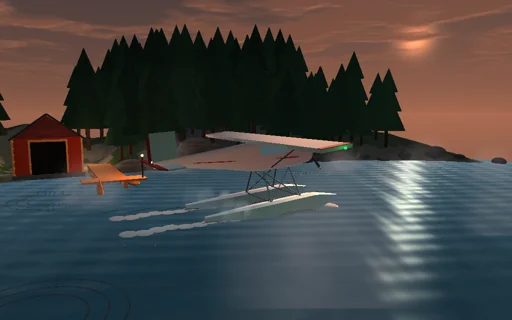
Open the throttle of a 1450 kg floatplane on a glassy lake at dawn and watch it climb out of the water. At first the two floats carry the whole weight by Archimedes’ law and plough bows up; as the speed grows the planing bottoms ahead of the steps lift them by Savitsky’s law, the water’s drag rises to its hump - about 2.8 kN at 11 m/s, a fifth of the weight - and falls as the wing, whose lift grows with the square of the speed, unloads the floats. The pilot holds the planing trim with the elevator in the propeller’s slipstream and rotates near the closed-form unstick speed: the floats leave the water after about 420 m and the aircraft clears 15 m after about 740 m. Try a flat or a steep trim - one wets the floats and runs twice as far, the other stays stuck behind the hump - add weight, raise the flaps, take off into the wind or in chop, or abort the run.
What happens
A 1450 kg floatplane (wing 16.2 m², aspect ratio 7.4, C_L = 0.3 + 4.9α + 0.022·flap°, rounded into C_Lmax = 1.55 + 0.02·flap°, C_D = 0.045 + 0.0006·flap° + C_L²/(πeA), e = 0.75) in the vertical plane: x, heave and pitch, I = 2800 kg·m². Two floats of 0.76 m beam, 18° deadrise: bow rise, 2.3 m planing bottom ahead of the step, 0.1 m step, 3.1 m afterbody swept up 9°. Buoyancy is ρg times the immersed prism under the (waved) surface, integrated exactly over 12 panels per segment, vertical through its centroid. The planing bottom adds Savitsky’s dynamic lift ½ρV²b²·C_Lβ, C_L0 = 0.012·λ^0.5·τ^1.1, C_Lβ = C_L0 − 0.0065β·C_L0^0.6, normal to the bottom at Savitsky’s centre of pressure, with the wetted keel D/sin τ; once the step ventilates (share u|u|/(u² + gb)) the hydrostatic pressure on the trimmed bottom drags B·tan τ; ITTC-1957 friction on the geometric wetted area; wave radiation damps heave and pitch (0.6·ρ·√(gb) per m² of waterplane). Thrust T = 5 kN·throttle·(1 − V/85 m/s); the tail (3.4 m², 4.9 m arm) in the slipstream V² + 0.6·2T/(ρA) holds the pilot’s trim with a PI loop, its download included; rotation at 0.92 of the closed-form unstick airspeed ½ρV²S·C_L + T·sin θ = W (29.5 m/s at 8°, flaps 20); lift-off when the lowest float point leaves the water, the distance to 15 m. Closed forms beside it: the trimmed quasi-static run ∫v dv/a(v), the stuck speed where a(v) = 0, the abort’s stopping integral. Forces are held over 1 ms sub-steps, Euler velocities, trapezoid positions, so the ledger closes to round-off: propeller = water + wing + tail + kinetic + potential.
Try this
Watch the floats plough, climb onto the step and leave the water, and compare the water run with the quasi-static integral and the unstick airspeed with the closed form; flatten or steepen the planing trim; add weight, raise the flaps, add a headwind or chop; press Abort before the unstick.
The model and its limits
A rigid floatplane in the vertical plane (x, heave, pitch) with both floats alike; box floats with an exact immersed volume, Savitsky’s empirical dynamic lift and centre of pressure for the planing bottom alone, a ventilation share and ITTC friction instead of a computed flow - no spray drag, no suction, no porpoising criterion, no cavitation; the afterbody carries buoyancy but no dynamic lift. Linear wing lift rounded into the stall, no ground effect, a linear thrust curve, a PI trim loop with a finite elevator; regular sinusoidal chop, still fresh water. Real take-off figures are certified, these are the model’s.
Equations used in the module
Equations
B = ρ·g·∫max(0, η − z_keel)·b·dx,  N = ½·ρ·V²·b²·C_Lβ,  C_L0 = 0.012·λ^0.5·τ^1.1,  C_Lβ = C_L0 − 0.0065·β·C_L0^0.6
R = N·sin τ + B·tan τ·u|u|/(u² + g·b) + ½·ρ·u²·C_f·S_wet,  C_f = 0.075/(log Re − 2)²
½·ρ·V²·S·C_L(θ + i_w) + T(V)·sin θ = W,  T = T0·(1 − V/V_p),  s = ∫ v·dv / a(v)
W_prop = W_water + W_wing + W_tail + ΔE_k + ΔE_p