Engineering
Steerable parachute
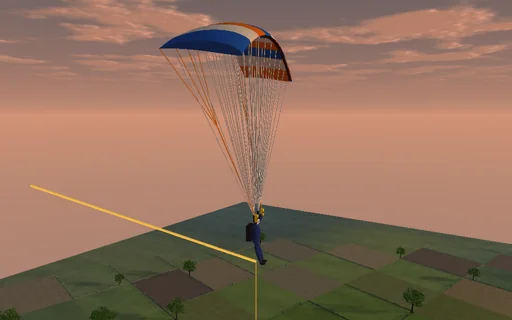
Fly a ram-air canopy down to the target cross of a drop zone at sunrise. Lift and drag follow the polar of the wing: both toggles pulled slow it and steepen the glide, one toggle banks it into a turn, and every steady glide, sink and turn radius matches its closed form - the glide ratio is CL/CD, and the speed grows as the air thins with height. A wind carries the whole flight along: the path through the air is unchanged and the ground track drifts by exactly the wind times the time. Flare at three metres and the canopy trades its speed for lift and touches down at under a metre per second; flare at ten and the speed is spent before the ground. Hand it to the autopilot, which crabs into the wind, holds downwind while it is high and flies the final into the wind on the brakes to land on the cross; every joule of height and speed is followed into drag.
What happens
A 95 kg pilot under a 21 m² ram-air canopy, flown as one point mass. Lift and drag follow the polar CL = 0.6 + 0.7 (bL + bR)/2, CD = 0.1 + 0.28 CL²: unbraked the glide ratio is 2.99, the best the wing can do; full brakes slow it from 10.9 to 7.3 m/s and steepen the glide to 2.27. The toggles follow their commands in 0.2 s; their difference banks the system towards 45° per unit with a 1.2 s lag and tilts the lift, so one toggle turns it on the radius V² cos γ/(g tan φ). The air thins with height by the standard atmosphere above a field at 500 m, so the canopy flies faster high up; a uniform wind carries the air frame and the ground track drifts by exactly the wind times the time. Below the flare height both toggles are pulled in proportion to the height lost below it, trading speed for lift. The autopilot crabs into the wind, circles at a holding point downwind of the cross while it is high, turns onto the final into the wind when the glide there needs the middle of its brake range, sets symmetric brakes so that the glide needs just the height that is left, releases them for the last 25 m and flares. RK4 in 10 ms steps; the drag work is integrated with the same weights, and the potential and kinetic energy lost in the air frame equal it. Map 1:100 with heights at the same scale; buildings, trees and the aircraft ×10, the canopy and its pilot ×15.
Try this
Watch the autopilot crab past the cross, circle downwind and fly its final into the wind; switch it off and steer with the toggles - both slow and steepen the glide, one turns; compare the touchdown sink with no flare, a flare from 3 m and one from 10 m; add wind and watch the ground track drift.
The model and its limits
A point-mass glider on a quasi-steady polar: no canopy pitch or pendulum swing, no stall, no inflation, a uniform wind without gusts or a gradient near the ground. Not a guide to parachuting and no judgement of human safety.
Equations used in the module
Equations
C_L = C_L0 + ΔC_L·(b_L + b_R)/2,  C_D = C_D0 + k·C_L²,  dφ/dt = (φ_1·(b_R − b_L) − φ)/τ
m·dv/dt = ½·ρ(z)·|v_a|²·S·(C_L·n(φ) − C_D·e) + m·g,  v_a = v − w
tan γ = C_D/(C_L·cos φ),  V² = 2W·cos γ/(ρ·S·C_L·cos φ),  R = V²·cos γ/(g·tan φ)
m·g·z + ½·m·|v_a|² lost = ∫D·|v_a| dt,  x_ground = x_air + w·t