Engineering
Thermal soaring
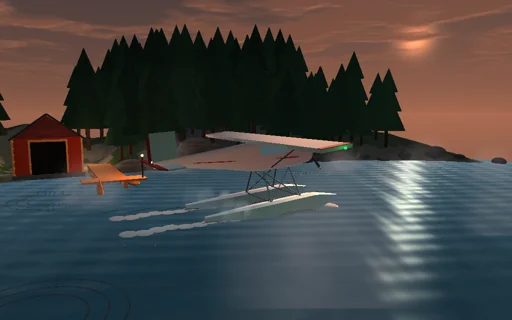
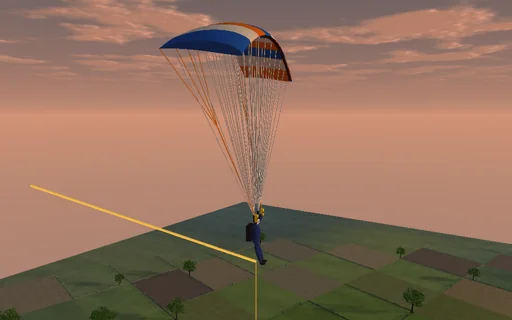
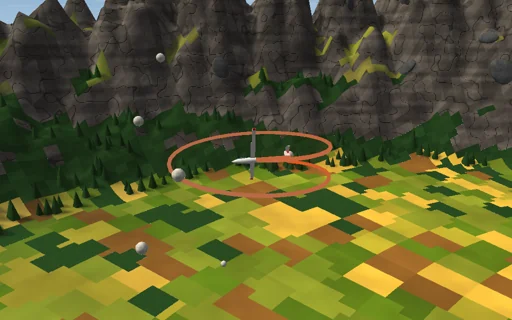
Soar a white 15 m sailplane over a broad alpine valley on a strong summer afternoon: circle in a thermal under its cumulus, climb toward cloud base, then glide to the next cloud and climb again. The speed polar a V³ + b/V gives the minimum-sink and best-glide speeds and a best glide of 40; in a Gaussian thermal the bank that climbs best is a closed form through Lambert’s W - too shallow and the circle lies outside the core, too steep and the circling sink eats the lift. Between thermals MacCready’s speed to fly is the tangent from the expected climb to the polar, and the measured cross-country speed follows V c/(c + w_s). Switch the centring off and an off-centre circle sinks out of the lift; weaken the thermal and the sailplane lands in a field. Every joule of height and speed is followed from the rising air into the drag.
What happens
A 15 m sailplane of 400 kg (10.5 m², aspect ratio 21.4, Oswald factor 0.92, C_D0 = 0.0095, C_Lmax = 1.6) is a point mass in still air of density 1.1 kg/m³. Lift ½ρV²S·C_L stands perpendicular to the airspeed, banked by φ about it; drag ½ρV²S·(C_D0 + k·C_L²), k = 1/(π·e·AR). Steady, that is the polar w_s = a·V³ + b/V, a = ρS·C_D0/2W, b = 2kW/ρS: minimum sink 0.65 m/s at 81 km/h, best glide 40.4 at 107 km/h; circling, the radius is V²/(g·tan φ) and the sink a·V³ + b/(V·cos²φ), with the exact helix (sin γ = D/W, L·cos φ = W·cos γ) solved beside it. Three Gaussian thermals w = W0·exp(−r²/R²), 3.5 m/s and 150 m, fade as 1 − ((z − z1)/300 m)² below cloud base at 2000 m. The best bank is closed form through the Lambert function: u = −2·W(−√(b·q/(V·W0))/2), q = V^4/(gR)², tan φ = √(q/u) - 47.8° and +1.76 m/s at 94 km/h; a concentric climb stops at z1 + 300 m·√(1 − s/w(r)) = 1932 m. MacCready’s speed to fly solves 2a·V^4 − c·V − 2b = 0 by Ferrari - 157 km/h at 1.8 m/s - and the cross-country speed is V·c/(c + w_s). The autopilot sets C_L for one g at the present speed plus PI on the error from a reference speed slewing at 4 m/s², rolls at up to 34°/s, keeps the level-turn C_L below 97 % of C_Lmax, centres by flattening the bank as the netto lift grows along the path and steers for the next cloud. Sub-steps of 20 ms hold C_L and the bank, take the force at the midpoint and move by the mean velocity, so m·g·z + m·v²/2 changes by exactly the air’s work minus the drag’s work, to round-off; leaving height, thermal entry, the finish line and a landing are located inside the step by bisection.
Try this
Watch the cross-country task: the climb at the optimum bank, the glide at the speed to fly and the leg speed against the prediction. Switch to Thermal and set the bank by hand from 25° to 60°; switch the centring off with an offset; fly Glide at different cruise speeds and read the glide ratio; add ballast and watch the speeds grow with √m. Keep the leave height below the ceiling.
The model and its limits
A point mass without rotational dynamics: the autopilot sets the bank through a roll-rate limit and C_L directly; a parabolic polar without the drag rise at high C_L; constant air density and no wind, so the thermals do not drift (left for a later stage); thermals as steady Gaussian columns of fixed strength without sink around them or turbulence; an ideal netto vario. The mountains are scenery the flight never meets. The valley is drawn at 1:300, the sailplane four times larger. A teaching model, not a flight trainer.
Equations used in the module
Equations
w_s(V) = a·V³ + b/V,  a = ρ·S·C_D0/(2W),  b = 2k·W/(ρ·S),  V_ms = (b/3a)^(1/4),  V_bg = (b/a)^(1/4),  (L/D)max = 1/(2√(C_D0·k))
c(φ) = W0·exp(−r²/R²) − a·V³ − b/(V·cos²φ),  r = V²/(g·tan φ),  tan φ* = √(q/u),  u = −2·W(−√(b·q/(V·W0))/2),  q = V^4/(g·R)²
m·dv/dt = L + D + m·g,  |L| = ½ρ·V_a²·S·C_L across v_a banked by φ,  |D| = ½ρ·V_a²·S·(C_D0 + k·C_L²),  v_a = v − w(x)·e_z
2a·V^4 − c·V − 2b = 0 (MacCready),  V_avg = V·c/(c + w_s(V)),  Δ(m·g·z + ½m·v²) = ∫F·w dt − ∫F·(v − w) dt