Engineering
Wave energy converter
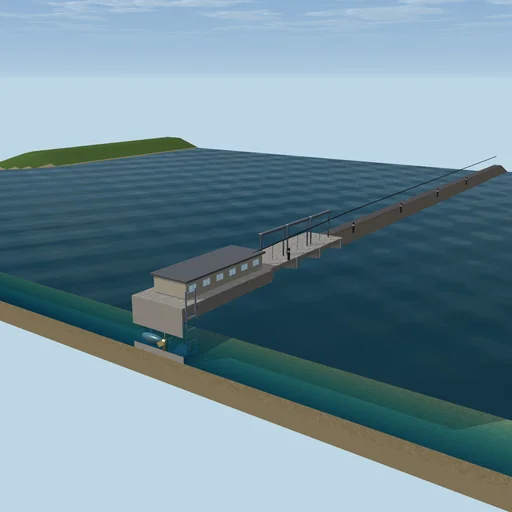
A float heaves on a pile in the waves and its linear generator brakes it. Tune the generator’s damping and the float’s mass to the waves and watch the mean power rise to the limit a heaving float can take, then send an irregular sea.
What happens
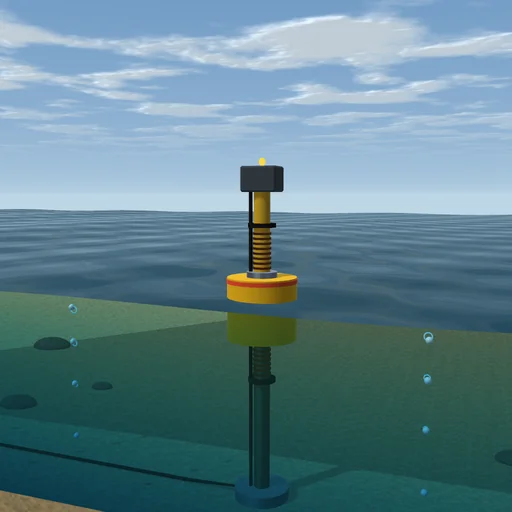
A float of 2.5 m radius heaves on a pile fixed to the seabed. It carries the magnets of a linear generator whose stator is the pile, so the generator brakes it with a force c·v. The waves are linear, in deep water: they push the float with the Froude–Krylov force ρgπR²·A·e^(−kd)·cos ωt, buoyancy springs it back with the stiffness ρgπR², and as it moves it makes waves of its own and loses energy to them through the radiation damping b, which Haskind’s relation ties to the same exciting force. The generator takes c·v², the radiated waves b·v².
The float of 60 t draws 2.98 m and has a natural period of 3.92 s. In waves 2 m high with a period of 6 s and c = 60 kN·s/m it heaves 1.04 m and gives 35.6 kW on average. The best damping for these waves, sqrt(b² + (K/ω − Mω)²) = 109 kN·s/m, gives 41.5 kW, and a fifth more or less damping still 40.6 kW. A float of 163 t resonates with waves of 6 s; with c = b it reaches the bound ρg³A²/(4ω³) of 211 kW – all the waves’ power along 8.95 m of crest, λ/2π – but it would have to heave 10 m. The stroke ends 3 m either way, where stiff end stops with damping take over. An irregular sea of three components gives 56.7 kW.
Model: one rigid body in heave; linear deep-water wave theory with an added mass of ρπR³/3 and the radiation damping at the wave’s frequency (no memory of past motion); the generator a linear damper of 90 % efficiency; RK4 at 1/60 s, finer near the stops. No drift, no mooring, no viscous losses.
Try this
Let the mean power settle, then press Match damping and watch it rise. Make the float heavier, towards 160 t for waves of 6 s: the power climbs until the float strikes the end stops.
Equations used in the module
Equations
(m + m_a)·x″ = F_e(t) − ρgπR²·x − (b + c)·x′
F_e = ρgπR²·A·e^(−kd)·cos ωt,  k = ω²/g
b = ρω³π²R⁴·e^(−2kd)/(2g)
c_opt = sqrt(b² + (K/ω − (m + m_a)·ω)²)
P_max = ρg³A²/(4ω³)