Engineering
Wind farm control
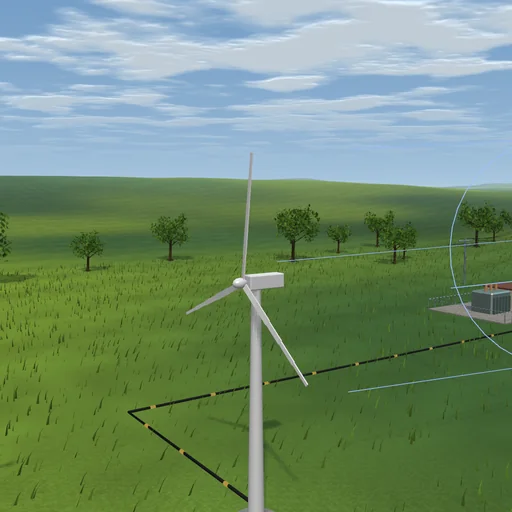
Three turbines stand in a row in the wind, and each one behind sits in the wake of those in front. Move them apart or aside, turn the wind, and let the front turbine yaw its wake away or pitch its blades to leave more wind for the others: see what the farm gives together.
What happens
Three turbines of 2 MW with rotors of 80 m stand in a row along the wind, 5 rotor diameters apart. Each rotor is a body on its shaft: the wind drives it with ½ρA·U³·Cp(λ, β)/ω, the generator holds it back with K·ω², which keeps it at the best tip speed ratio, and at rated speed a controller turns the blades, at most 8°/s, so that the generator gives 2 MW. Behind each rotor the wind is slower – the Jensen wake, whose edge spreads by 0.075 for every metre downstream and whose deficit follows from the rotor’s thrust; wakes add as squares, and a rotor feels the share of a wake that overlaps it. A yawed rotor pushes its wake sideways (Jiménez).
Alone in 8 m/s a turbine turns at 1.62 rad/s and gives 719 kW. In a row at 5 diameters the second gets 7.07 m/s and gives 497 kW, the third 6.97 m/s and 475 kW: the farm gives 1.69 MW, 21.6 % less than three free turbines; at 8 diameters 1.85 MW. Moving the middle turbine 0.75 diameter aside gives 1.84 MW; yawing the front one by 7° steers its wake further away: 1.857 MW. Pitching the front turbine by 4° lets more wind through, but it loses more than the others gain: 1.56 MW.
Model: each rotor one degree of freedom with Heier’s analytic power curve; the thrust from the rotor’s own Cp by momentum theory; the wakes stationary – they follow the upstream rotor at once – and of uniform deficit across; the wake only slows the wind. Steps of 0.05 s.
Try this
Read the three turbines’ power in the row, then move the middle one aside. Switch on coordinated control and yaw the front turbine a few degrees: watch its wake move.
Equations used in the module
Equations
P = ½ρA·U³·Cp(λ, β),  λ = ωR/U
J·dω/dt = P/ω − K·ω²
δ = (1 − sqrt(1 − C_T))·(R/(R + k·x))²
δ_tot = sqrt(Σ δ_i²)