Astronomy / Earth
Eclipse geometry and Saros
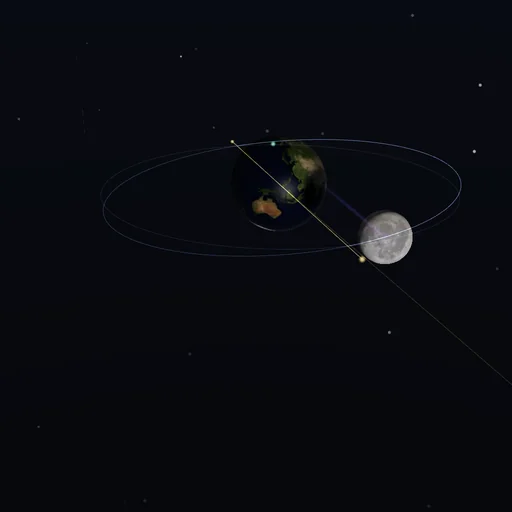
Why a new moon is usually not an eclipse, what decides total against annular, and why the pattern repeats every eighteen years and eleven days. The Moon's orbit tilted 5° with its line of nodes, the umbra and penumbra as cones that reach the Earth or fall short, an observer at any latitude who sees the discs at their true sizes, and a table of the run's eclipses with the one a Saros later beside each. An idealised orbital model - circular orbits, mean motions - so it explains eclipses and dates none.
What happens
The Moon's orbit is tilted five degrees to the Earth's, so at most new moons the Moon passes above or below the Sun and its shadow misses the Earth by thousands of kilometres. Only when the new moon falls near a node - where the two planes cross - does the shadow axis hit, and that happens in seasons half a year apart. Whether the eclipse is total or annular is a matter of a few hundred kilometres: the umbra is about as long as the Moon is far, so near perigee it reaches the ground and near apogee it ends in space and a ring of Sun remains. After 223 synodic months the Moon, the Sun and the node come back to nearly the same arrangement - the Saros - and the eclipse repeats, a third of the way round the Earth. This is an idealised model: circular orbits and mean motions; it explains the geometry and dates no real eclipse.
Equations used in the module
Equations
γ = (closest approach of the shadow axis to the Earth's centre) / R_E
r_umbra = R_M − d (R_S − R_M)/d_SM,   r_penumbra = R_M + d (R_S + R_M)/d_SM
Saros: 223 synodic = 6585.32 d ≈ 242 draconic = 6585.36 d
real sky: λ_M = L' + 6.289° sin M' + 1.274° sin(2D − M') + …; d_M = 385 001 − 20 905 cos M' − … km; θ_G = 280.461° + 360.9856° d