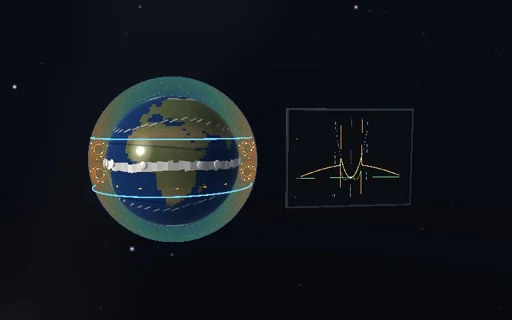
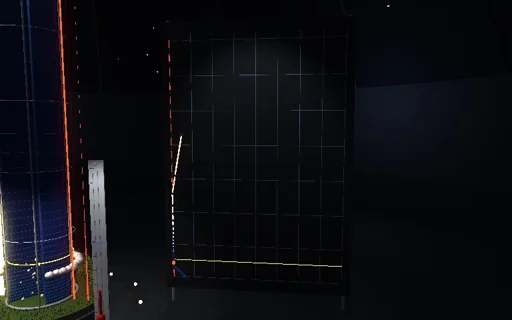
Spin up a planet’s atmosphere from rest and watch the Hadley cells grow out of the tropics until Held and Hou’s closed form says they must stop: air rising at the equator keeps its angular momentum on the way poleward, so the upper wind becomes Ω·a·sin²φ/cos φ, a subtropical jet, and the cell reaches only as far as the equal-area construction allows - 26.5° for the Earth, not the 28.8° of the small-angle formula. Beneath it the trade winds turn to westerlies where the angular-momentum budget says, and their torques cancel. Slow the planet and the cells widen towards the poles; stop it and one cell fills each hemisphere with no zonal wind at all. Move the heating six degrees north and the ascent jumps to 21°, the winter cell a hundred times stronger than the summer one, as Lindzen and Hou found; let the seasons run and the ITCZ swings 18° each way, two months late.
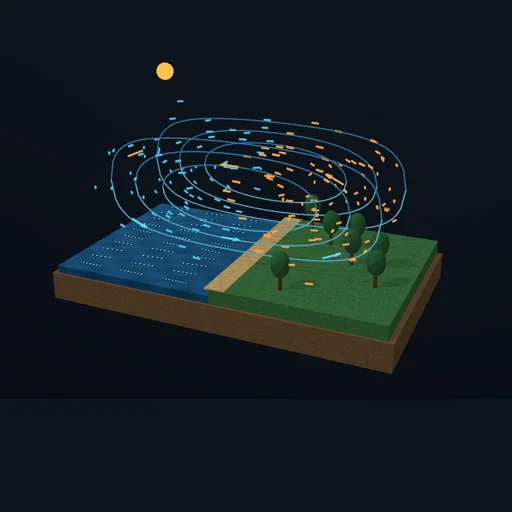
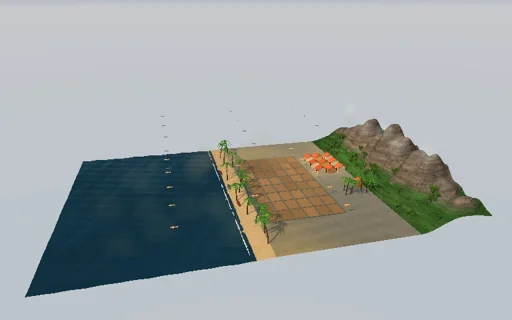
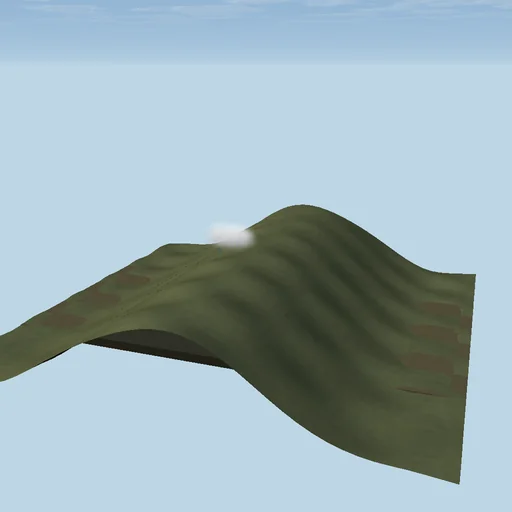
Follow a South-Asian coast through the year. The same sun heats the shallow land and the deep sea, but the land answers within days and the sea two months late, as the closed-form gain 1/sqrt(1+(ωτ)²) and lag atan(ωτ) say. Their contrast drives an overturning wind; onshore it brings the sea air’s moisture, and the rain’s latent heat strengthens the very circulation that brought it. So the monsoon does not grow gently: once the land’s forcing turns positive the rain jumps to a deluge within a week, dark clouds roll in from the sea and pile against the hills, the paddies flood and turn green; it holds on into the autumn until the forcing falls below the fold R_c = −M²/(4Dκ). Hold the season and the coast is bistable: a moist surge flips it wet, lowering the heating or the moisture past the closed-form threshold dries it for good. The moisture budget closes to round-off.
Watch a cold front pass over a small town on a hazy summer afternoon. Cold air, seven degrees colder and two kilometres deep, is released from the west and runs under the warm air as a density current: its nose moves at Benjamin’s Fr·√(g’h) on top of the steering wind, with the depth behind it and the speed both as Rottman and Simpson’s closed form says, and Ritter’s fan behind. The warm boundary layer is lifted over the cold air; above its condensation level it makes a dark shelf cloud with a roll cloud along the nose and a rain curtain behind. The town’s weather mast and meteogram record the temperature drop, the pressure jump ρg’h, the gust and the veering wind. Switch to Margules’ geostrophic fronts, tilted at f·Δv·T/(gΔT): a cold front carried by the wind, or a warm front with rain ahead and falling pressure. Without a density contrast nothing moves at all.
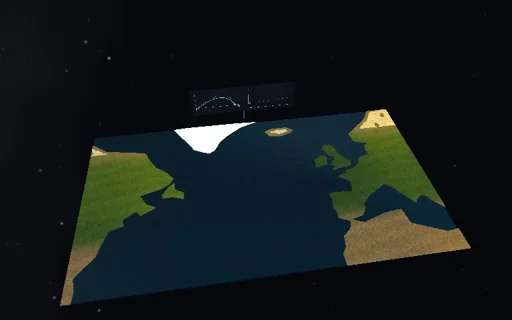
Watch a storm being born over the North Atlantic, seen from orbit. Cold air to the north and warm air to the south mean, by the thermal wind, a westerly wind that strengthens with height - and that sheared flow is unstable. A ripple of half a hectopascal grows exponentially, at exactly the rate the two-layer Phillips model gives in closed form, fastest for waves about 3.5 Rossby radii long, some 4000 km; in a few days lows deepen below 985 hPa, highs build, the comma cloud rises where the warm air climbs ahead of each low and a cold-front band trails behind it. The growth stops when the storms have carried enough heat poleward to slacken the gradient. Flatten the temperature gradient and the wave only decays; compare two wavelengths started alike; the board plots the growth rate against wavenumber and books the eddy energy against its release from the mean available potential energy.
Spin up a tropical storm over a warm sea at dusk: the sea gives heat to the inflowing air at its surface temperature, the outflow gives it up a hundred degrees colder at the tropopause, and this Carnot engine sets the strongest wind the storm can reach - the potential intensity. Over a sea that does not cool the wind follows the closed-form tanh law up to that limit; let the storm stir up the cold water beneath it and it holds itself lower, much lower over a shallow warm layer; shear the vortex and it settles weaker; take it ashore and, with no heat supply and rougher ground, the wind decays exactly as V0/(1 + C_D V0 t/2h). With no temperature difference there is no engine at all.
Watch a summer afternoon build a thunderstorm over the prairie: the sun heats the ground, the mixed layer deepens along the dry adiabat and eats into the cap above it, and the lifted parcel - dry to its condensation level, then saturated along the pseudo-adiabat - shows its CAPE and CIN on a sounding board beside the sky. Fair-weather cumulus sit at cloud base, about 125 m up for every kelvin of dew-point depression, until the thermals carry the parcel past its level of free convection; then the tower climbs at the plume’s speed, an entraining updraft well below the closed-form sqrt(2 CAPE), and spreads into an anvil at the equilibrium level. Its rain sets off a cold downdraft whose gust front chokes the cell. Strengthen the cap and the storm never comes; dry the air aloft and the outflow turns colder.
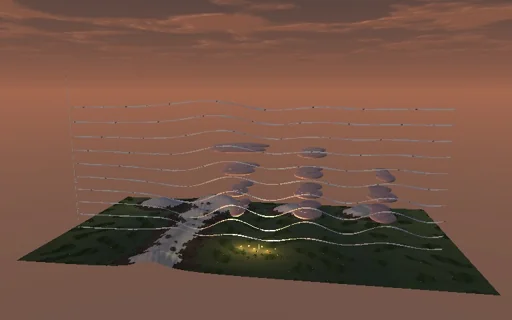
Watch the evening wind cross a snowy ridge: stable air pushed up the windward flank springs back and oscillates downwind, and the steady linear wave field - the Scorer equation solved mode by mode - is drawn as smoke ribbons rising and falling over and behind the ridge. Over a broad ridge in uniform air the waves climb straight up as Queney’s solution, with a vertical wavelength 2πU/N and a drag of (π/4)ρNUh0²; under a less stable layer aloft a train of lee waves is trapped downwind, its crest spacing the closed-form trapped mode, longer as the wind grows, until above a critical speed nothing is trapped. Lenticular clouds stack where moist layers are lifted past their condensation level, a glider climbs in the lift until it equals its sink, and a ridge too high for the wind is flagged where the streamlines would overturn.
Look down on the northern hemisphere in the polar night: the jet stream glows as a ribbon round the pole, coloured by its wind, with cold Arctic air tinting the ground blue on its poleward side and warm air orange on the other. Its strength is the thermal wind of the equator-to-pole contrast, 25 m/s for 40 K at 500 hPa. Its meanders are Rossby waves of the barotropic vorticity equation: a free wave drifts east at the closed-form c = U − β/(k²+l²), far slower than the balloons riding the wind, and stands still when U = β/K². The Rockies and Tibet force waves locked to the mountains. Weaken the contrast as a warming Arctic does and the jet slows, the stationary waves grow shorter and the troughs reach further south; over a single-wave ridge the slower jet falls into resonance, the mountain drag holds it there and the wave stays blocked even when the contrast comes back.
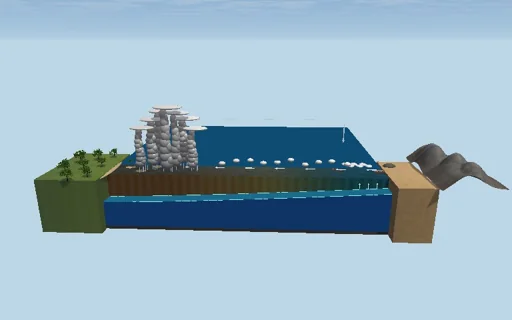
Watch El Niño come and go across the equatorial Pacific, cut open from Indonesia to Peru: the trade winds pile warm water in the west and lift the cold thermocline in the east; warm the east and the trades weaken, the thermocline flattens and the east warms further - the Bjerknes feedback - while the slow discharge of the warm-water volume turns the event into La Niña about a year and a half later. Below a closed-form critical coupling the swing dies away, at it the oscillation neither grows nor fades and its period is 2π/ω from the linear eigenvalues, above it a limit cycle settles at the amplitude of weakly nonlinear theory. Send a westerly wind burst or a noisy atmosphere and watch the rain clouds migrate east; switch the atmosphere off and the oscillation is gone.
Follow every watt of sunlight through a column of air standing on a slice of the Earth in a dark observatory hall. A lamp-sun pours in 340 W/m²; a cloud deck and the ground send 30 % back to space, the air absorbs a third of the rest, and thirty grey layers pass the infrared up and down. Start the column frozen at 170 K or hot at 360 K and watch both settle on the same radiative-convective equilibrium near 288 K: the critical lapse rate up to a tropopause near 9 km, 350 W/m² of back radiation, 123 W/m² carried up by convection, 237 W/m² leaving the top. Switch off convection and the ground climbs to 332 K; strip the air away and it falls to Te; one opaque layer gives 2^(1/4) Te. Double CO2 for 3.7 W/m² of forcing and 1.2 K of warming, 2.8 K if water vapour follows; turn forest into desert or ocean and watch the surface settle in weeks or years.
Watch a planet’s ice caps in the light of its sun: each latitude band absorbs sunlight according to its albedo, radiates to space and shares heat with its neighbours. Today’s sun puts the ice edge near 66 degrees; dim it slowly and the edge creeps towards the equator until, at nine tenths of today’s sunshine, the bright ice reflects so much that the whole planet freezes over in one jump. Brighten the sun again and the snowball stays frozen far past where it froze - it thaws only at more than six fifths. Make ice and water equally dark and the feedback is gone: the equilibrium is then the closed-form P2 solution in every band.
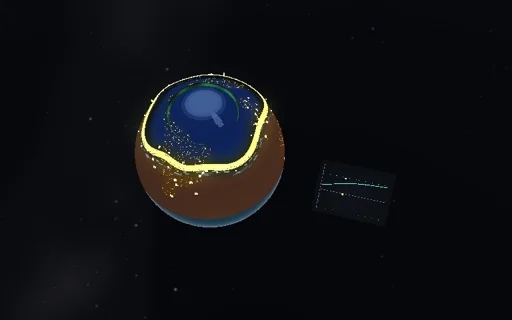
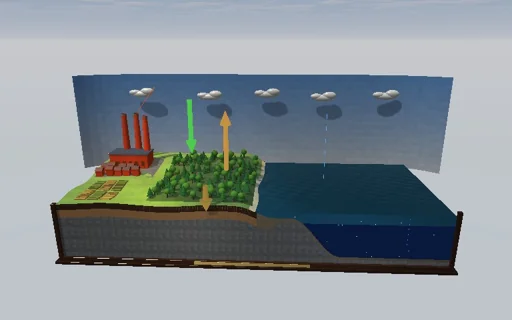
Follow every petagram of carbon through a museum relief of the Earth: chimneys burn fossil carbon into the air, the forest draws it down and drops it into the soil, the soil breathes it back faster as the world warms, and the ocean dissolves it - first the thin surface layer, whose buffer chemistry takes only a tenth of what its size suggests (the Revelle factor), then over centuries the deep ocean. Replay the industrial era: 667 PgC by 2025 bring CO2 to 426 ppm with 47 % still airborne; hold the emissions and CO2 passes 580 ppm by 2100, reach net zero in 2050 and it falls back towards 329 ppm. Release the same carbon at once or over two centuries, clear the forest, and watch the cycle share it out again: the multi-exponential response of the linearised cycle, its equilibrium partition and an exact carbon ledger are shown beside it.
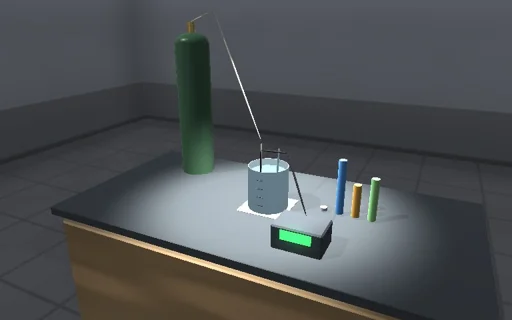
Bubble air of a chosen CO2 through a beaker of seawater on a laboratory bench and watch the indicator change colour. The water’s dissolved carbon and alkalinity fix its pH and the shares of dissolved CO2, bicarbonate and carbonate ion, with the published constants of Lueker, Dickson, Millero, Weiss and Mucci; the Revelle factor says why the water’s CO2 pressure rises ten times faster than its carbon. Raise the air’s CO2 and the carbonate ion falls until, near four thousand micro-atmospheres, the water can no longer keep aragonite: the shell on the bottom begins to dissolve, and its two units of alkalinity for every carbon buffer the water back to just under saturation. Cold water of the same chemistry holds less carbonate. Carbon in water, shell and air is conserved to rounding.
Watch the smoke of a brick factory chimney drift over a terraced town at dawn. The hot exhaust rises by Briggs’s plume rise, then the wind carries it downwind while the turbulence of the chosen Pasquill class mixes it towards the ground: in a sunny unstable morning it loops down within a few hundred metres, in a neutral one it touches the town a couple of kilometres away, in a calm stable night it fans out aloft and barely reaches the roofs. Let an inversion lid trap it over the houses, or set the lid below the plume and the town stays clean. A ribbon over the roofs draws the ground-level concentration beside the Gaussian plume, a station reads it; with a uniform wind and a constant K the slab settles onto the exact steady plume, its ground maximum 2Q/(eπuH²). Stop the source and watch what is left blow out of the valley; the emitted mass always equals what is in the air, deposited and gone.
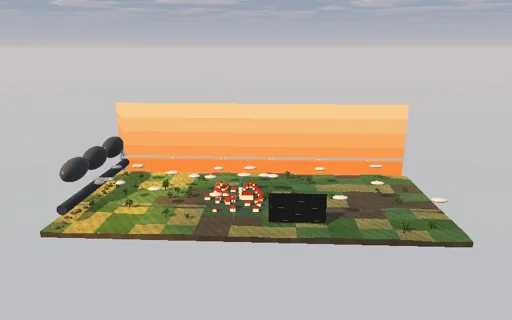
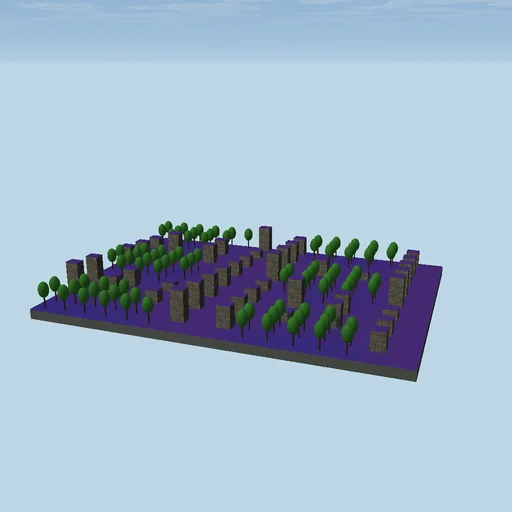
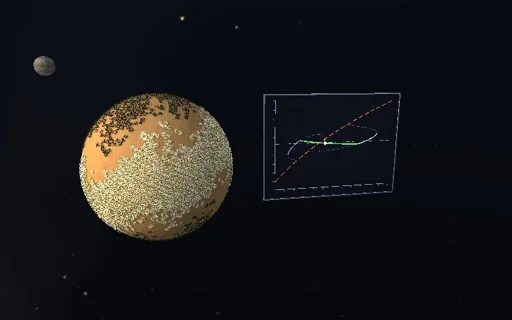
Walk around a little planet covered with daisies as its sun grows brighter. Black daisies absorb sunlight and warm themselves and the planet, white ones reflect it and keep cool; both grow best at 22.5 °C. So the faint young sun is met by black daisies, the bright old one by white ones, and in between both together hold the planet within a few degrees of the optimum while the bare planet would warm by forty - the closed-form coexistence branch on the board, its local temperatures exactly 5 K either side of the optimum. Push the sun past 1.54 and the whites collapse in one jump; dim it again and they return only at 1.22 - sweep and watch the hysteresis drawn. Switch to the desert: plants bring their own rain, and at the same rainfall a green savanna and a bare desert are both stable, until a drought tips the green one over for good. Areas are booked to round-off.
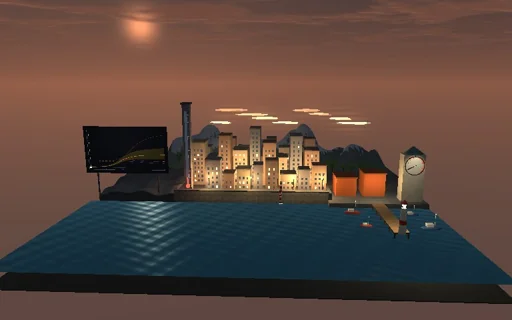
Watch a coastal city at dusk across its bay from 1850 to 2300 while the climate answers the carbon dioxide we add: the surface and the upper ocean warm within years, the deep ocean takes centuries, and the sea rises against the harbour wall as the water expands and the ice melts. Follow the low, medium, high or overshoot pathway, or hold the concentration from today and see the warming go on - the deep ocean is still catching up. Double CO2 at a stroke and the warming follows two exponentials, a fast one of four years and a slow one of over two centuries; raise it by 1 % a year and read the transient response at doubling; set off a volcano and watch a few tenths of a degree of cooling fade. Change the sensitivity and the ocean and the board redraws every pathway; the energy taken in is booked against the heat stored and radiated away to round-off.
Some modules belong to more than one Suite. Shared experiments have one description here.