160 interactive modules bring geometry, topology, fractals, calculus, algebra, probability and algorithms into view. Rotate a surface, change a construction or follow an algorithm one step at a time.
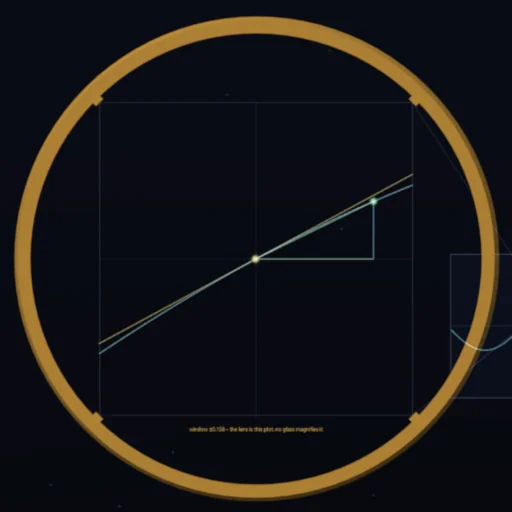
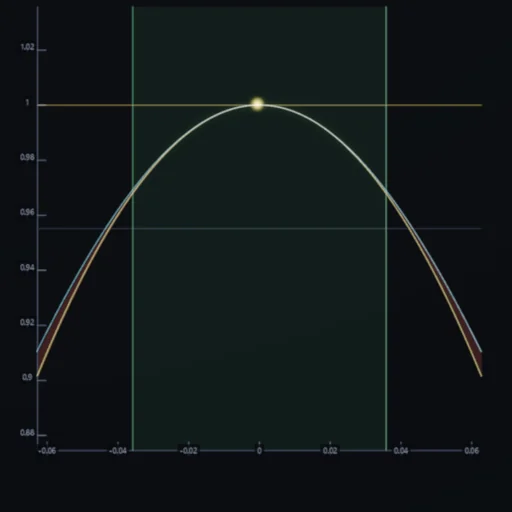
Zoom in on a smooth curve with the vertical scale locked to the horizontal one and it straightens: that is what a derivative is, and the secant through two points walks onto the tangent as they close. Then the same lens on a corner, a cusp and a curve whose difference quotient settles on nothing - three different failures, drawn as two tangents, a vertical one and none. And the part nobody is told: in floating point a smaller step stops helping near 1e-8 and then makes the answer worse, because subtracting two nearly equal numbers throws away the digits that carried the answer.
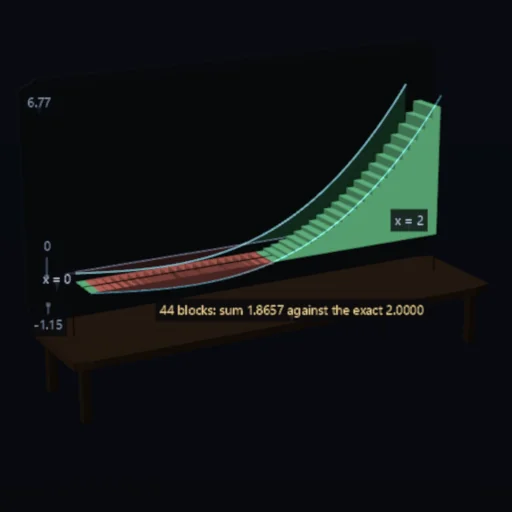
Fill the region under a curve with panels and watch the count climb: the choice of where each panel takes its height decides everything, and the trapezoid that follows the curve is exactly twice as bad as the midpoint rectangle that does not. Then the sign, because the integral of a sine over one period is zero while the area between it and the axis is four. And the accumulated function, whose slope is the curve you started from - except where the curve jumps, and there it has a corner instead.
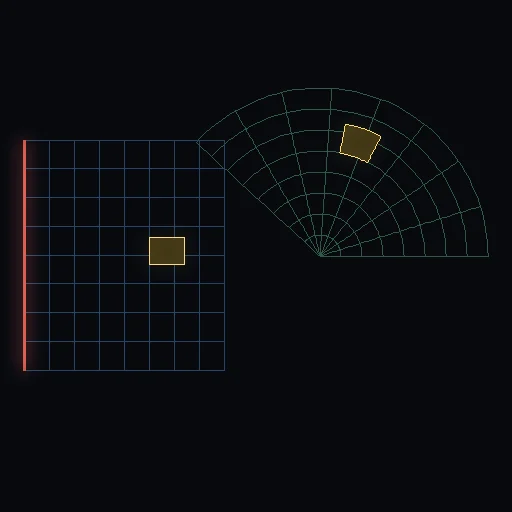
Change variables in an integral and a factor appears; everyone learns to write r dr dθ and few are shown where the r comes from. It is the determinant of the map's derivative - the ratio between a tiny cell's area and its image's, measured here on the polygons themselves. Three things that determinant is not: the sign is an orientation and not part of the factor, a vanishing determinant means an edge collapsed rather than cells got small, and the integral of |det J| equals the image's area only when the map covers it once. z → z² covers the unit disc twice and the total is out by exactly two.
Every other way of computing gives a number that is probably right. Interval arithmetic gives a pair that is certainly right, and the whole subject is what that costs. It costs sharpness, and the cost has a name: every occurrence of a variable is treated as a different variable, so x − x comes out as an interval two units wide. Which means the enclosure is a property of the FORMULA, not of the function - rewrite x(1 − x) as 0.25 − (x − 0.5)² and the width falls from 1 to the true 0.25; write x·x instead of x² in 1/(1 + 25x²) and the answer becomes the entire real line.
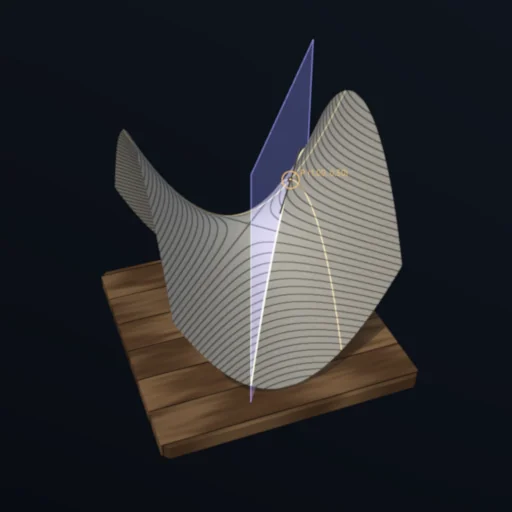
Cut a surface with a vertical plane and you get a curve; its slope is the derivative in that direction. Turn the plane and watch the slope change, then plot it in polar coordinates: for a differentiable surface that plot is exactly a circle with the gradient as its diameter, so the gradient being the steepest way up stops being a claim and becomes a picture. And one surface here has both partial derivatives, a directional derivative in every direction, and no tangent plane at all - the formula ∇f·u predicts zero while the surface climbs at 0.385, because existing is a weaker thing than differentiable.
Near its centre a Taylor polynomial is indistinguishable from the function, and adding a term always pays. Away from it, three different things go wrong: outside the radius of convergence more terms make the answer worse without limit; exp(−1/x²) has a series that converges everywhere and equals the function at one point; and even inside the radius, summing far from the centre can throw away every digit. The radius itself is the distance to a singularity that is not on the real line at all, so a third scene draws the complex plane, where the answer actually lives.
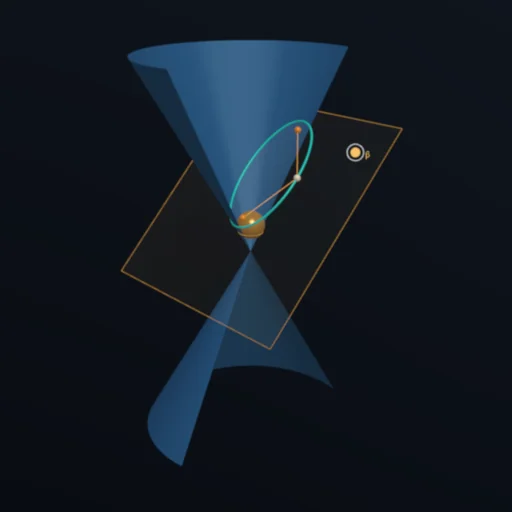
Drag the gold β handle to tilt the plane. Try each preset, then switch on the Dandelin spheres. Right drag rotates; the wheel zooms. The right view uses true distances in the cutting plane. The moving point measures the focus/directrix ratio e. A circle has e = 0 and no finite directrix. q describes the horizontal projection.
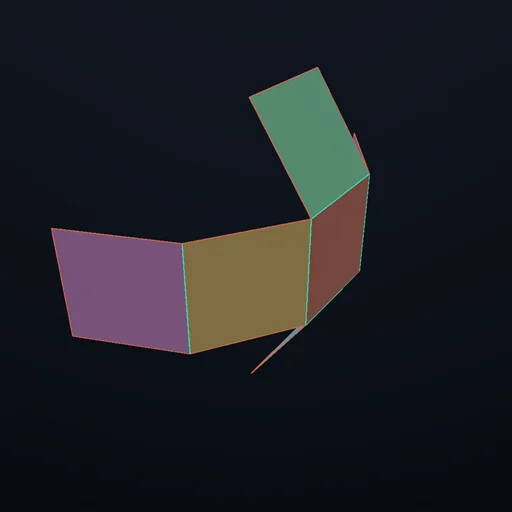
Cut a solid along some of its edges and open it flat. The uncut edges must keep every face connected without a loop - a spanning tree of the face graph - and every such tree is a net. The solid opens along its hinges by composed rotations, the net's area is checked against the surface, every pair of faces is clipped to prove nothing overlaps, and the nets are counted up to the solid's symmetries: two for the tetrahedron, eleven for the cube, eleven for its dual.
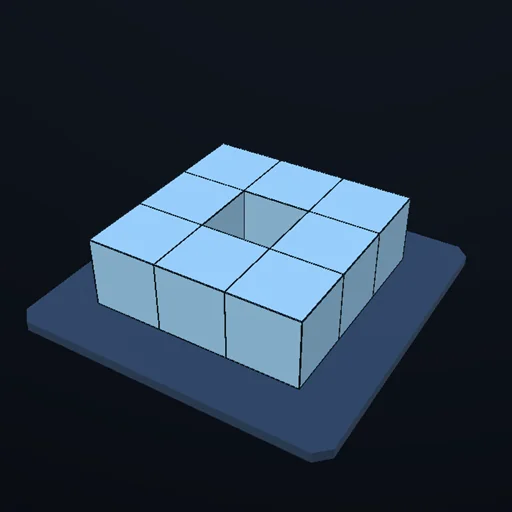
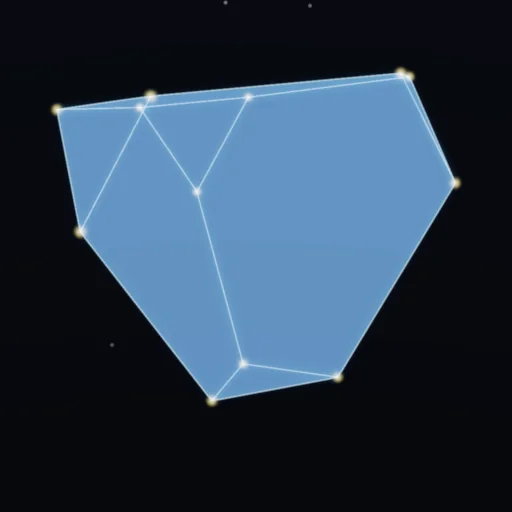
A solid body of a few dozen faces, and V − E + F read off it after every edit: triangulate a face, put a vertex in it, split or erase an edge, cut a face out, refine them all - a ledger shows what each does to V, E and F and that χ moves only when a hole is cut. The genus comes from χ with its conditions stated: how many pieces, how many boundary loops, orientable or not - on a Möbius band the formula gives cross-caps instead.
What a four-dimensional solid looks like from inside three-dimensional space: only its slice, and the slice changes as the solid moves through. A tesseract coming corner-first shows a tetrahedron that grows, loses its corners, becomes an octahedron and shrinks back; cell-first it shows one cube for the whole passage. The slices are built from the crossed cells, counted, measured, and their volume integrated over the passage is the 4-volume in every orientation - Cavalieri, one dimension up.
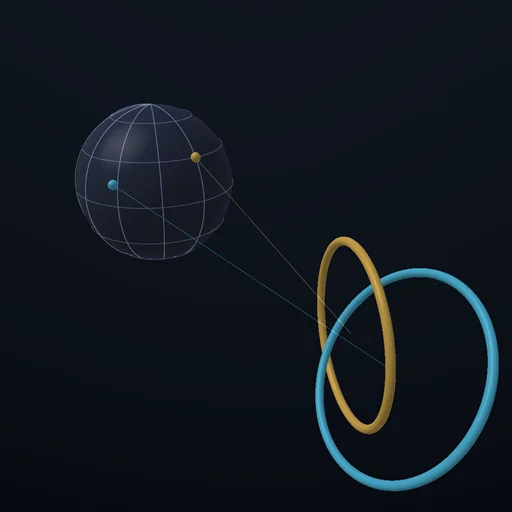
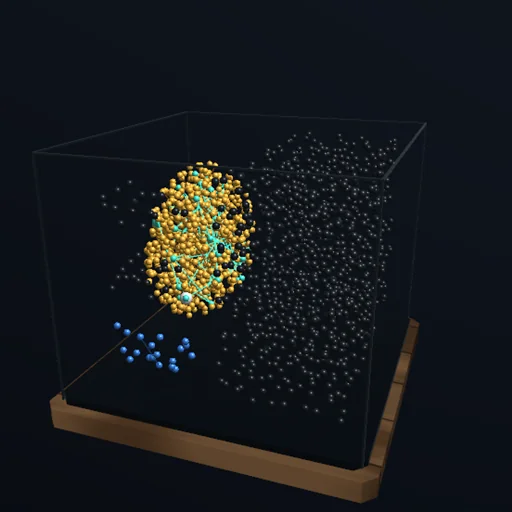
Every point of an ordinary sphere has a whole circle above it in the sphere of four dimensions, and those circles fill it without ever crossing - yet any two of them are linked, exactly once, however far apart their points are. Drag a point on the small globe and watch its circle move on the big picture; take a whole circle of latitude and the circles weave a torus. The linking number is measured by Gauss's integral, and the angle between two circles comes out at half the angle between their points - which is why a qubit's Bloch sphere has radius one half.
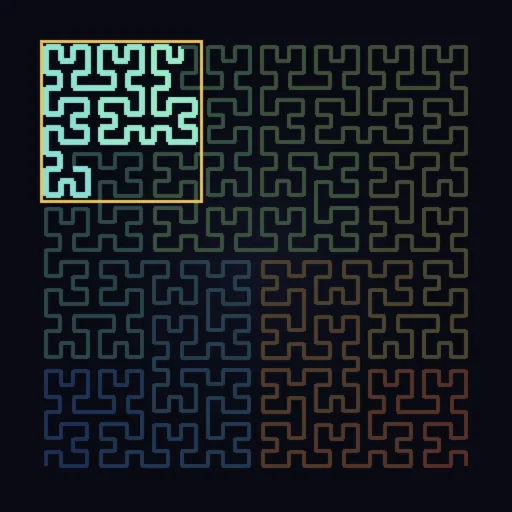
A line has no area, and yet a curve can pass through every point of a square - Peano found one in 1890, Hilbert drew his in 1891. At each order the curve visits every cell exactly once, moving one cell at a time, and the limit is continuous. Drag the marker: a tenth of the curve stays inside about a third of the side, which is why databases and image formats index space along this curve. The reverse is false, and the panel measures that too - two touching cells can be five sixths of the curve apart.
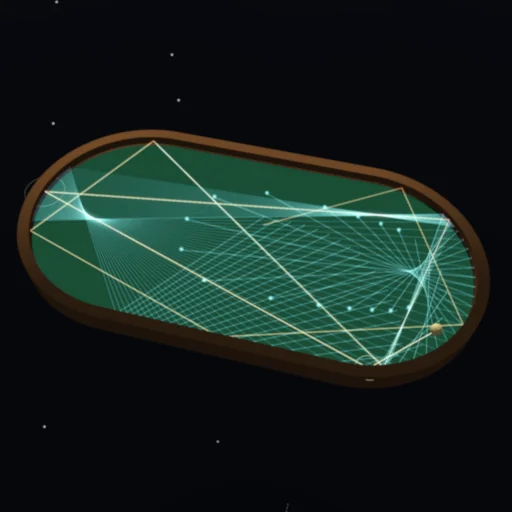
A point bouncing inside a wall with equal angles, for ever. Inside a circle the angle never changes: the path avoids a smaller circle it can never enter, and a rational rotation closes into a polygon. Inside a stadium - two half-circles joined by straight walls - nothing is conserved but the speed, and two paths a billionth of a degree apart are a table's width apart after twenty bounces. The panel measures that: the separation is fitted against an exponential AND against a straight line, and which one fits is the answer.
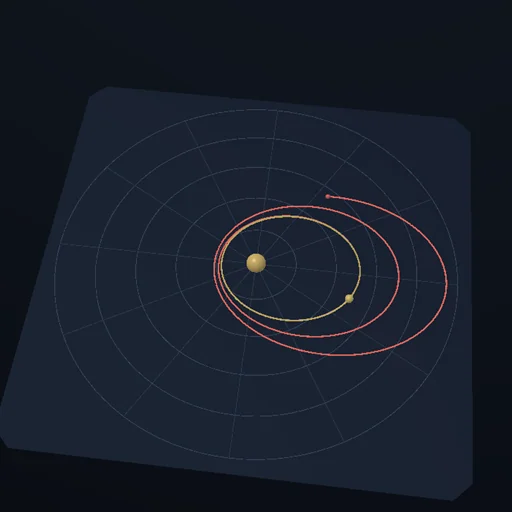
A computer cannot follow a trajectory; it can only take steps. Halving the step divides the error by two, four or sixteen depending on the method - until so many steps accumulate round-off that a smaller step makes the answer WORSE. On an orbit the most accurate method of the four still loses energy in a straight line while a less accurate one merely wobbles for ever, because accuracy and respect for an invariant are different virtues. And in a chaotic system the path is doomed whatever the method: what survives is the attractor, not the trajectory.
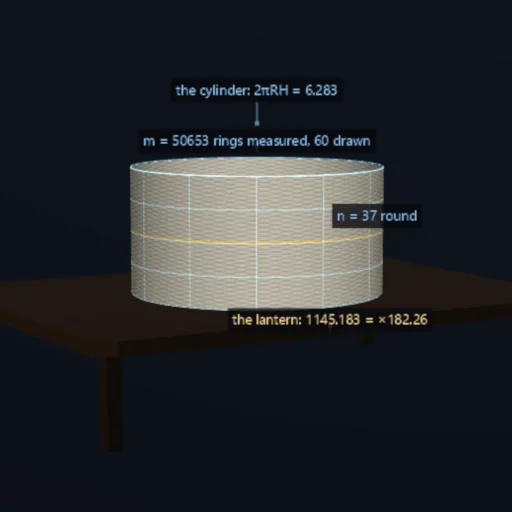
An approximation can hug a curve as closely as you please and still have the wrong length: a staircase converging to a diagonal is 41 % too long at every refinement, for ever. One dimension up it is worse. Schwarz's lantern has every vertex on a cylinder and triangles as small as you like, and its total area tends to the true 2π, or to five times that, or to infinity - depending only on how its two refinements race each other. What decides is not the size of the pieces but their tilt, and the panel measures it.
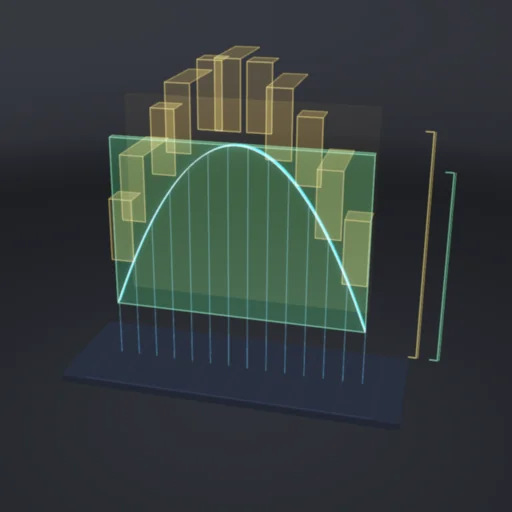
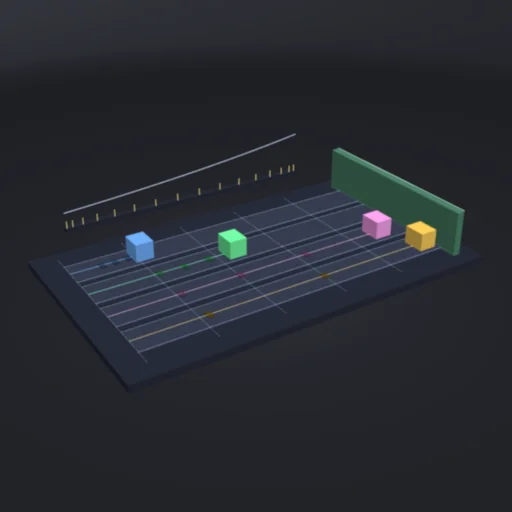
Accuracy is bought with work, and the exchange rate is not a property of the method. Four rules integrate the same function and the currency is how many times the function is read: the race is run on a chart of error against evaluations with a tolerance line you set, after you predict the winner. On a smooth function Gauss reaches machine precision in eight readings where the trapezoid rule needs sixty-five thousand; put one kink in the function and every high-order rule collapses to the same crawl. And past ten million terms the additions themselves lose six digits.
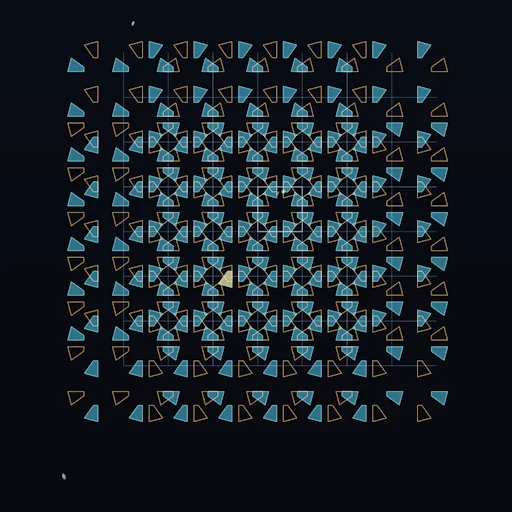
The seventeen wallpaper groups, each built from one or two generators and applied to a motif you drag; mirrored copies in a second colour, so rotations, reflections and glides can be told apart by eye. The group's order, its rotations and its mirrors read off the elements, not off the name. And the eighteenth pattern - Penrose rhombi - with thick and thin counts walking to the golden ratio.
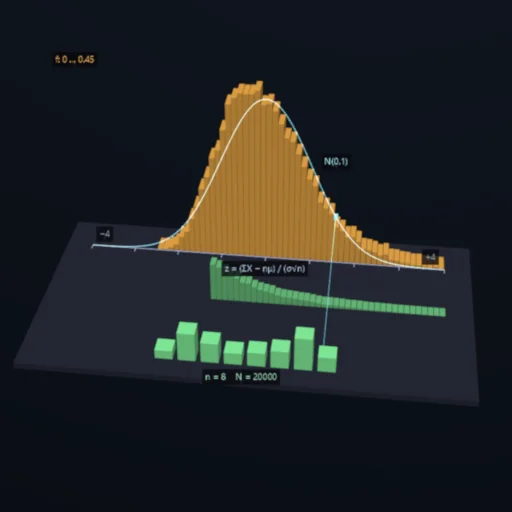
Add up draws from any shape - a die, a loaded coin, two humps, the long tail of a waiting time - and the standardised sum turns into the same bell. One sample is collected before your eyes and becomes one point of the series beside it; the sum, the mean and the standardised sum are three names of that point. Cumulants of a sum add, so the skewness falls as 1/√n and the excess kurtosis as 1/n, and the sheet measures both. And one source breaks it: a Cauchy has no variance, and no bell ever appears.
Some modules belong to more than one Suite. Shared experiments have one description here.